 Mycoscout
The short answer
You cannot tell if a mushroom is poisonous by looking at it, smelling it, tasting a bit, or applying any folk test. Minnesota Poison Control's answer to "can you tell by looking?" is "in most cases, you can't". Poisonous mushrooms are identified the same way edible ones are: by the species, read from the whole mushroom, the spore print and the habitat, and by knowing which deadly groups share its look. If someone has already eaten a wild mushroom you cannot name, do not wait for symptoms: US Poison Help 1-800-222-1222, free and open 24/7; UK NHS 111, or 999 if they are unwell.
Folk rules that fail
Every poison center and extension service keeps a list of these, because every year they hurt someone. Michigan State University's bulletin lists the traditional "tests" and calls them "invariably false".
| The rule | Why it fails |
|---|---|
| "A silver spoon or coin turns black if it's poisonous" | Poison centers say all mushrooms darken or bruise when damaged; silver reacts to nothing specific in a toxic one. |
| "If the cap peels, it's safe" | Listed by MSU among the false folk tests. |
| "Animals eat it, so it's fine" | MSU: "Squirrels and rabbits can safely eat the Amanita mushrooms, which are deadly poisonous to people." Slug damage proves nothing. |
| "Poisonous mushrooms are brightly colored" | Toxic species can be pure white or plain brown. The deadliest are white, olive or tan. |
| "They smell or taste bad" | Deadly Amanitas are reported to be good-tasting. Tasting a little and waiting fails because the worst toxins act after 6 to 24 hours. |
| "Cooking destroys the poison" | Minnesota Poison Control states that cooking a poisonous mushroom does not remove the poison. The death cap's toxin is not reduced by freezing or cooking. |
| "Mushrooms growing on wood are safe" | Another MSU "invariably false" test. The deadly galerina grows on wood and contains the same toxins as the death cap. |
| "It looks like the ones in the shop" | The California health department warns that deadly species "can even look like mushrooms sold in grocery stores" at some stages. |
What actually works: identify the species
MSU's bulletin puts it in capitals: the only reliable way to tell a poisonous mushroom from an edible one is to learn to identify the species. That means reading the whole mushroom, not the cap.
- Dig up the base. MSU: dig up each mushroom "to get the entire base. Do not simply cut the stalk at the soil line." A white sac (volva) at the base, usually buried, is the signature of the deadly Amanitas.
- Look at the gills or pores: their color, whether they are free from the stem or run down it, and whether they change color with age.
- Check for a ring on the stem, or the remains of a cobweb veil.
- Take a spore print. It takes a couple of hours on paper and separates whole families; see how to take a spore print.
- Note the habitat: grass, soil under a particular tree, wood, dung. Some deadly species only grow with certain trees.
- Cut it lengthwise for flesh color, staining and the hidden outline of a cap inside a "puffball".
- Name the look-alikes of whatever you think it is, and rule each one out feature by feature.
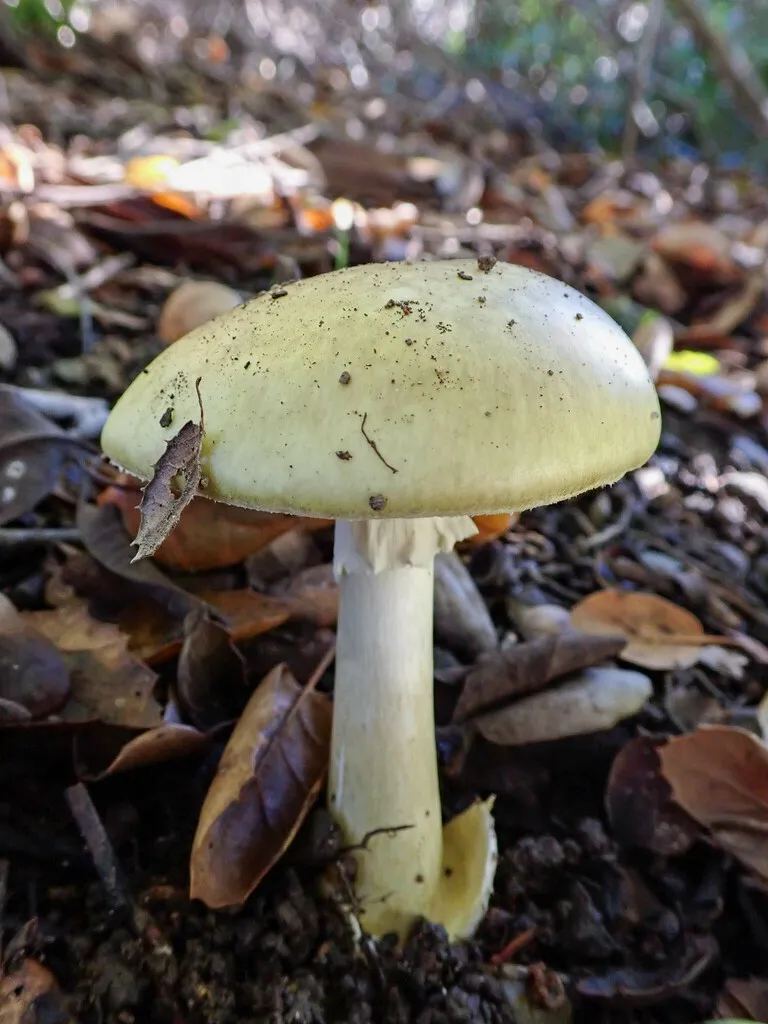
Features that point at the deadly groups
A few groups cause nearly all deaths. Knowing what they look like lets you rule them out, which is the only version of "how to tell if a mushroom is poisonous" that works.
| Deadly group | Features to check | Symptom delay |
|---|---|---|
| Death cap (Amanita phalloides) | Olive, yellow-green or white cap; white gills that stay white; skirt-like ring; white sack-like volva; white spore print; under oaks and other trees | GI symptoms within 5 to 12 hours, then false recovery, then liver and kidney damage |
| Destroying angels (Amanita virosa, A. bisporigera, A. ocreata) | Pure white throughout; ring; sack-like volva usually buried deep; white spore print; woodland and grass under trees | As above |
| Funeral bell / deadly galerina (Galerina marginata) | Small brown cap; fragile pale ring; snuff-brown spore print; on stumps and dead wood | Same amatoxins as the death cap |
| Deadly webcap (Cortinarius rubellus) | Orange-brown cap; cobweb veil remains on the stem; rusty reddish-brown spore print; with conifers on acid soil | Kidney damage after two or three days or longer |
Two practical consequences. First, a white spore print plus a ring plus a sac means Amanita, and that combination alone should end any thought of eating. Second, small brown mushrooms with a brown print on wood are a group you simply leave alone, because the funeral bell is only told from edible relatives by details a beginner cannot judge. Read the death cap, destroying angel, deadly galerina and deadly webcap pages, and the comparisons honey fungus vs deadly galerina and deadly webcap vs chanterelle.
Why one feature is never enough. Many poisonous mushrooms have no ring and no sac; the green-spored parasol has a ring but no sac and still sends people to hospital. Ruling out the deadly Amanitas is necessary, not sufficient. Every feature has to match the species you have in mind, and every look-alike has to be excluded.
Poisonous without being deadly
Most mushroom poisonings are miserable rather than fatal. NAMA's syndrome list puts gastrointestinal irritants such as the green-spored parasol at symptoms within 20 minutes to 4 hours, and names it the most common cause of mushroom poisoning in North America. The yellow stainer and the jack-o'-lantern sit in the same group. A short delay is reassuring only once a poison center has heard what was eaten; MSU notes that the most dangerous toxins "rarely cause symptoms before six hours", which is why early vomiting does not rule out a mixed meal.
If someone has already eaten one
- Call now. US: Poison Help 1-800-222-1222, free, 24/7; Minnesota Poison Control says "Do not wait for symptoms to appear." UK: NHS 111 if you are not sure, 999 or A&E if they are unwell.
- Do not make them vomit. The NHS warns they could choke.
- Keep the mushroom. Bag any leftovers and dig up another of the same kind, base included. Photograph the cap, the gills and the base. The NHS advises taking some of the substance to hospital.
- For a dog or cat, call your vet or an animal poison line; see what to do if your dog ate a mushroom.
Using an app to check a mushroom
An app will not tell you a mushroom is poisonous with certainty, and it cannot make a folk rule work. What it can do is organize the checks above. Mycoscout asks for the cap, gills, stem with base and habitat, leads every result with the edibility verdict, shows its confidence, gives a checklist of features to confirm on the real mushroom and names the dangerous look-alikes with how to tell them apart. Treat the verdict as a prompt to check, not a conclusion; it never clears a mushroom for eating, and a local mycological society with the whole specimen remains the standard. How Mycoscout works.

Frequently asked questions
How do I know if a mushroom is poisonous in the UK?
The same way as anywhere: identify the species from the whole mushroom, including the dug-up base and a spore print, and rule out the deadly groups (death cap, destroying angel, funeral bell, deadly webcap). No shortcut works. If someone has eaten one and you are not sure, call NHS 111; call 999 if they are unwell.
How to tell if a mushroom is poisonous or just inedible?
Not by looking. There is no visual test for toxicity; the deadly species are identified by features such as a white spore print, a ring and a sac at the base, and are often small, brown or plain white.
Can you touch a poisonous mushroom?
Touching is not how mushroom toxins act. HealthLinkBC says touching death caps is not a risk, and suggests gloves if you prefer and washing your hands with soap afterward. The danger is eating any part of it, and small children who handle one may put their fingers in their mouths.
Does cooking make a poisonous mushroom safe?
No. Minnesota Poison Control states that cooking a poisonous mushroom does not remove the poison, and First Nature notes the death cap's potency is not reduced by freezing or cooking.
If I feel fine a few hours after eating a wild mushroom, is it safe?
No. The deadliest toxins cause no symptoms for 6 to 24 hours and the deadly webcap for days. Feeling fine is not evidence. If you ate an unidentified wild mushroom, call Poison Help (US 1-800-222-1222) or NHS 111 now.
Sources
How we checked this page: the Mycoscout team cross-checked every edibility, toxicity and look-alike statement against the sources below on October 31, 2026. It has not been reviewed by a mycologist.
- Don't Pick Poison When Gathering Mushrooms for Food in Michigan (E2777), Michigan State University Extension. Accessed October 31, 2026.
- Poisonous Mushrooms: Myths vs. Facts, UVA Health (with the Blue Ridge Poison Center). Accessed October 31, 2026.
- Wild Mushrooms, Minnesota Poison Control System. Accessed October 31, 2026.
- Mushroom poisoning syndromes, North American Mycological Association. Accessed October 31, 2026.
- Amanita phalloides, Deathcap, First Nature. Accessed October 31, 2026.
- Galerina marginata, Funeral Bell, First Nature. Accessed October 31, 2026.
- Cortinarius rubellus, Deadly Webcap, First Nature. Accessed October 31, 2026.
- Death cap mushrooms (Amanita phalloides), HealthLinkBC. Accessed October 31, 2026.
- Poisoning, NHS. Accessed October 31, 2026.
- Poisonous Wild Mushrooms, California Department of Public Health. Accessed October 31, 2026.
