 Mycoscout
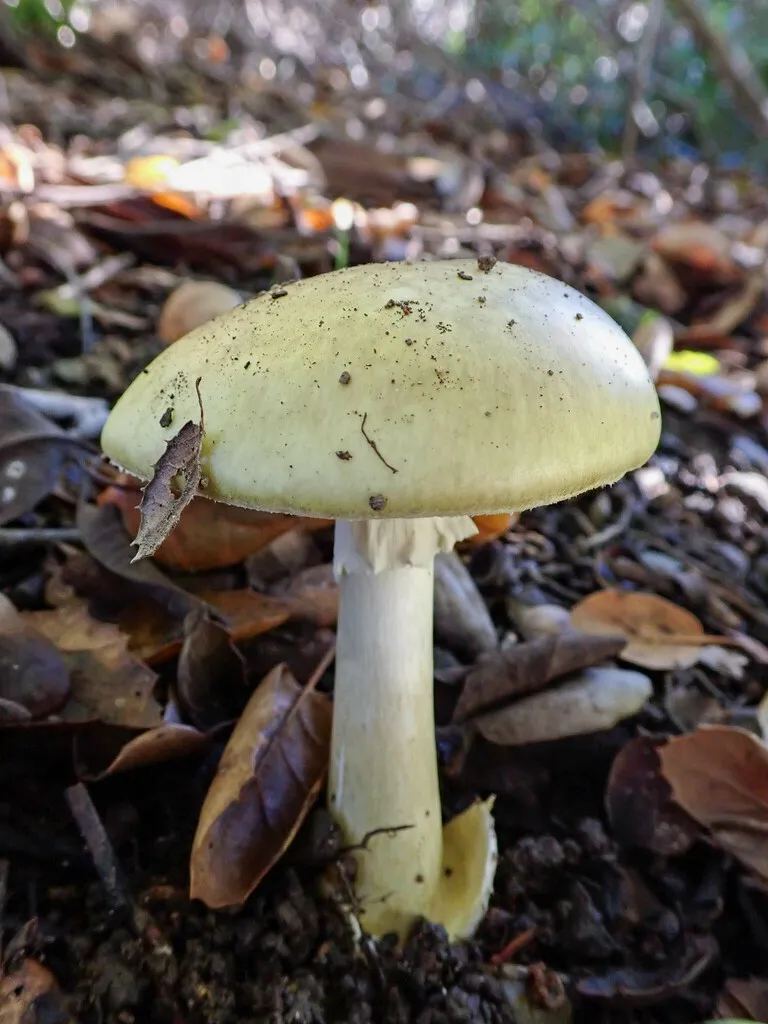
How to identify a death cap
The death cap is a medium to large mushroom with a smooth olive-green, yellow or bronze cap, white gills, a white stem with a floppy skirt-like ring, and a white cup-shaped sac (the volva) around the base. Young ones are white eggs that look like puffballs. No single feature confirms it; the combination does, and the base is the part people forget to look at.
| Feature | Death cap (Amanita phalloides) |
|---|---|
| Cap | 5–15 cm across. Almost white when young, then yellow, olive or bronze, often darker in the centre with faint radiating fibres. Egg-shaped at first, then flat. Smooth; veil patches usually wear off. |
| Gills / underside | Free of the stem, broad, crowded. Pure white at first, cream or faintly pink with age. |
| Stem & base | 7–15 cm tall, off-white with faint zig-zag mottling. A fragile, hanging white ring high on the stem. The base sits in a large white sac, often tinged green inside and often buried. |
| Flesh | White. Does not change colour when cut. |
| Spore print | White. |
| Smell | Almost none when young; sickly sweet when old. |
| Habitat | On the ground with trees it partners with: oak and beech in Europe, coast live oak and other oaks in California, pines in the eastern US. Also in mown grass near those trees. |
| Season | UK and Europe: July to November. California: after autumn and winter rain, peak October to April, with smaller flushes at any time of year. |
| Range (US / UK & Europe) | Introduced to North America: common under oaks from California to British Columbia; isolated populations in Massachusetts, New Jersey, New York and New Hampshire. Common across Britain, Ireland and mainland Europe. |

Confirm these features
Dig up the whole mushroom, base included, and check all of these. A missing feature means you cannot call it; it never means it is safe.
- A white sac or cup around the base of the stem (it may be buried, so dig, do not pull).
- A white skirt-like ring high on the stem, often floppy and sometimes torn away.
- White gills that are free of the stem and stay white or cream, never pink then brown.
- A smooth cap in olive, yellow, bronze or greenish-white, without warts or scales.
- A white spore print taken overnight.
- Growing on the ground near oak, beech or pine, not on wood.
Why one feature is never enough: a death cap can lose its ring, a dry cap can look almost white, and a young one has no visible gills at all. An edible field mushroom has no sac; a puffball has no gills; a paddy straw mushroom has a sac but pink spores. The sac, the white gills and the white print have to be checked together, every time.
Dangerous look-alikes
Destroying angel (Amanita bisporigera, A. ocreata, A. virosa)
Tell apart: pure white cap and stem with no yellow, olive or green; otherwise the same ring, white gills and sac. Risk: the same amatoxins, the same outcome. Confusing one for the other changes nothing. See death cap vs destroying angel and the destroying angel page.
Edible button-stage mushrooms and puffballs
Tell apart: a young death cap is a white egg. Cut it top to bottom: a developing cap, gills and stem inside the egg mean an amanita; a giant puffball is solid white all the way through. Risk: young amanitas have poisoned people who thought they had puffballs. See puffball vs amanita.
Field mushroom and other Agaricus species
Tell apart: the field mushroom has gills that start pink and turn chocolate brown, a brown spore print and no sac at the base. Death cap gills stay white. Risk: both grow in grass in autumn, and a very pale death cap in a lawn looks like a shop mushroom at a glance.
Paddy straw mushroom (Volvariella volvacea)
Tell apart: the paddy straw has a sac but no ring, and its gills turn pink with a pink spore print. Risk: in the 2025–26 California outbreak many patients told doctors the mushrooms looked like edible kinds they knew from other countries. A sac at the base is not enough to call a mushroom edible anywhere.
False death cap (Amanita citrina)
Tell apart: pale lemon cap with veil patches on it, a rimmed bulb rather than an open sac, and a smell of raw potato (First Nature: the flesh of young ones "smells rather like a cut raw potato"). Risk: low toxicity in itself, but anyone separating the two on cap colour alone is one step from eating a real death cap.
Where and when it grows
The death cap partners with living tree roots, so it appears on the ground, often in loose groups, within reach of the tree. In Britain and Ireland it is fairly common under oak and beech from July to November. It is found across mainland Europe, mostly at low altitude.
In North America it is an introduced species. Research from Harvard (Anne Pringle) showed the California population came from Europe, probably on imported trees, and in parts of California it now makes up most of the local mushroom biomass. There it grows with coast live oak in urban parks as well as wild oak woodland, and fruits after the first heavy rains, with a peak season of October to April; the two largest recorded outbreaks ran from November to December 2016 and from November 2025 to March 2026, both in northern California. Its range runs north into British Columbia, where the BC Centre for Disease Control reports it on Vancouver Island and in the Lower Mainland, brought in on the roots of imported boulevard trees in Victoria and Vancouver. On the East Coast there are isolated populations near Newton (Massachusetts), the New Jersey Pine Barrens, Rochester (New York) and New Hampshire, where it grows with pines rather than oaks. Reports from other states are not well documented; treat any olive-capped, white-gilled mushroom with a sac as a death cap until an expert says otherwise.
Death caps also turn up in lawns and parks when the right tree is nearby, which is how children and dogs meet them. Our guide to mushrooms in the lawn covers what to do.
Symptoms and why the delay matters
The death cap contains amatoxins, mainly alpha-amanitin, which damage the liver and kidneys. They are heat stable: cooking, drying and freezing do not destroy them. Poison centers say this of every poisonous mushroom, and the CDC says it of amatoxins specifically.
The delay is what makes this mushroom so dangerous. According to the North American Mycological Association, nothing happens for 6 to 24 hours after the meal (the 2016 California patients fell ill after 4 to 12 hours, most often around 9). Then comes about a day of violent vomiting, watery or bloody diarrhea and cramps. The symptoms then ease for roughly a day, and patients have been sent home at this point. During that false recovery the liver and kidneys are already failing. The relapse brings liver failure, bleeding problems and, without specialist care, death. Of the 14 patients in the 2016 outbreak, 3 needed liver transplants and 1 child suffered permanent brain injury; of 39 patients in 2025–26, 4 died and 3 received transplants.
If anyone may have eaten one, use the emergency numbers at the top of this page now. Do not wait to see if symptoms appear; by then the toxin has been absorbed. Keep a piece of the mushroom for identification.
Using an app to check a find
A photo can show the cap colour, the ring and the gills, but it cannot show a sac that is still under the soil or the colour of a spore print, and those are the two features that separate a death cap from edible look-alikes. Mycoscout asks for four angles, cap, gills, stem with the base and habitat, puts the edibility verdict at the top of the result, shows how confident it is and names the look-alikes to rule out. A result of "Deadly, do not eat" is worth acting on; any other result for a mushroom like this is not a clearance to eat. iNaturalist is a free way to get human identifiers to look at your photos, and a local mycological society can examine the whole specimen, which no app can.
Frequently asked questions
Where do death cap mushrooms grow?
Across Britain, Ireland and mainland Europe under hardwoods, especially oak and beech. In North America it is an introduced species: common under oaks in California and north to British Columbia, with scattered populations on the East Coast (Massachusetts, New Jersey, New York, New Hampshire), where it grows with pines.
Can you touch a death cap?
Handling one is not reported as a route of poisoning; the toxins act when the mushroom is eaten. Wash your hands afterwards and never let a child or dog mouth one. Any amount eaten needs a call to poison control now, before symptoms start.
What is the difference between a death cap and a destroying angel?
Both are deadly amanitas with white gills, a ring and a sac at the base. The death cap usually has an olive, yellow or bronze cap; the destroying angel is pure white all over. A pure white one is no safer. See our death cap vs destroying angel page.
Does cooking a death cap make it safe?
No. The amatoxins are heat stable and survive cooking, drying and freezing. The CDC and poison centers say plainly that cooking does not make a poisonous mushroom safe.
How long after eating a death cap do symptoms start?
Usually 6 to 24 hours, often around 9 to 12 hours. Vomiting and watery diarrhea then come on hard, ease for a day, and liver and kidney damage follows. Call poison control as soon as you suspect it; do not wait for symptoms.
Sources
How we checked this page: the Mycoscout team cross-checked every edibility, toxicity and look-alike statement against the sources below on October 31, 2026. It has not been reviewed by a mycologist.
- Mushroom poisoning syndromes: amatoxins, North American Mycological Association. Accessed October 31, 2026.
- Amanita phalloides Mushroom Poisonings — Northern California, December 2016 (MMWR 66:549–553), Centers for Disease Control and Prevention. Accessed October 31, 2026.
- Amanita Species Mushroom Poisonings — Northern California, November 2025–March 2026 (MMWR 75), Centers for Disease Control and Prevention. Accessed October 31, 2026.
- Amanita phalloides, Deathcap, First Nature. Accessed October 31, 2026.
- Deathcap (Amanita phalloides), Woodland Trust. Accessed October 31, 2026.
- Killer mushrooms (research by Anne Pringle on the introduced death cap), Harvard Gazette. Accessed October 31, 2026.
- Wild mushrooms, Minnesota Poison Control System. Accessed October 31, 2026.
- Death Cap Mushrooms, BC Centre for Disease Control. Accessed October 31, 2026.
- Amanita citrina, False Deathcap, First Nature. Accessed October 31, 2026.
