 Mycoscout
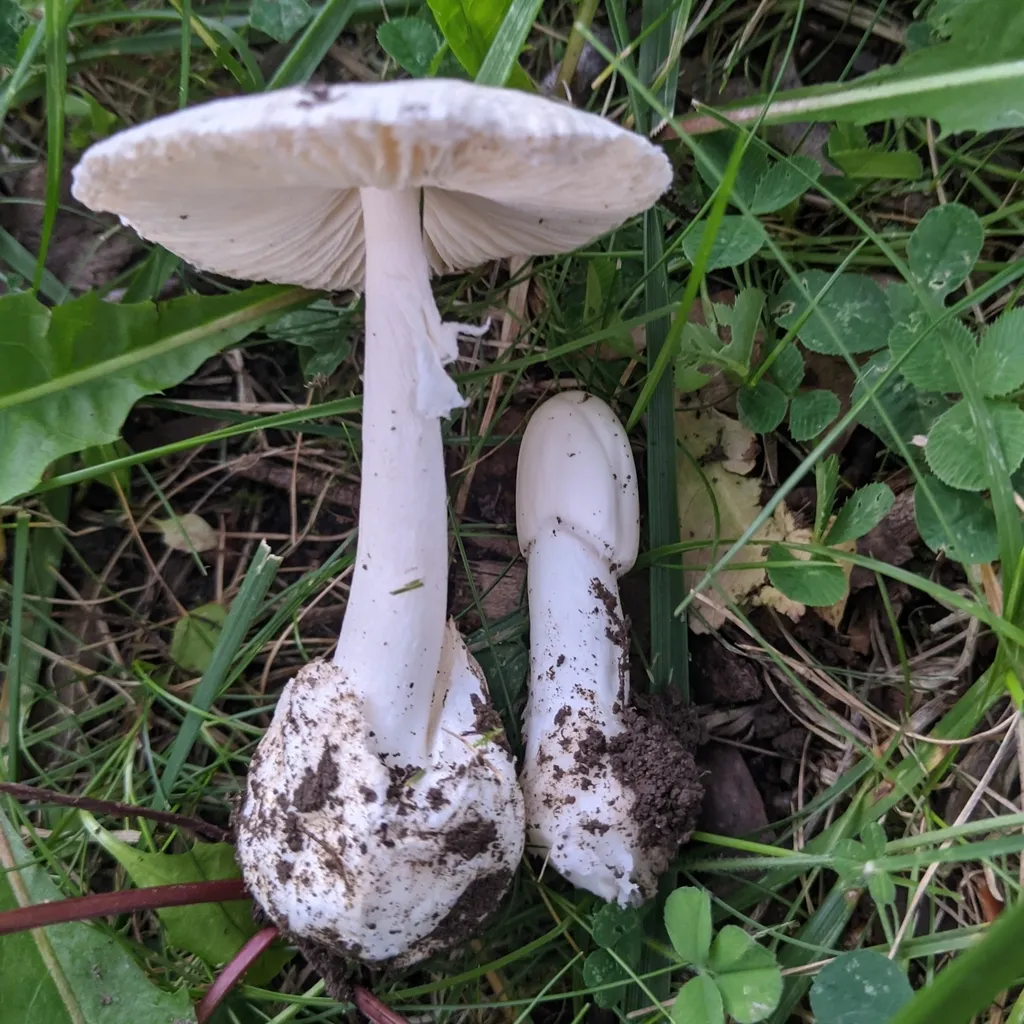
How to identify a destroying angel
A destroying angel is a slender, all-white amanita: smooth white cap, white free gills, a thin skirt ring high on the stem and a white sac (volva) around the base, which is usually hidden in the soil. Several species share the name. In eastern North America it is mainly Amanita bisporigera; on the West Coast A. ocreata, the western destroying angel; in Britain and northern Europe A. virosa. DNA work has shown that A. virosa does not occur in the United States, whatever older field guides say. For a forager the differences do not matter: all of them are deadly.
| Feature | Destroying angel |
|---|---|
| Cap | 5–10 cm across (A. bisporigera 2.5–10 cm, up to 13 cm reported in Missouri). Pure white to ivory, sometimes faintly darker in the centre. Egg-shaped, then bell-shaped or nearly flat, often tilted on the stem. Smooth and slightly sticky when wet. |
| Gills / underside | White, crowded, free of the stem or almost so. They stay white. |
| Stem & base | 9–15 cm tall (A. bisporigera 5.5–14 cm), white, often slightly curved; smooth to shaggy. A thin, fragile, skirt-like white ring near the top, easily lost. A white sac around a swollen base, usually buried. A. ocreata is stockier. |
| Flesh | White, unchanging. The cap surface of A. bisporigera, A. ocreata and A. virosa turns yellow with a drop of potassium hydroxide (KOH), a test some foragers carry. |
| Spore print | White. |
| Smell | Faint and sickly, or none when young; old specimens of A. bisporigera smell foul. Never taste it. |
| Habitat | On the ground with trees, especially oaks; also in grass at woodland edges and in lawns near trees. |
| Season | A. bisporigera: June to November, mainly summer and fall. A. ocreata: peaks October to April in California. A. virosa: August to November in Britain, July to September in northern Europe. |
| Range (US / UK & Europe) | A. bisporigera: eastern North America from Texas to the north woods and the Maritime provinces. A. ocreata: California and the Pacific Northwest. A. virosa: across Britain and Ireland, more common in the uplands and in Scotland, very common in Scandinavian conifer forests. |


Confirm these features
- The whole mushroom is white: cap, gills, stem and ring. No pink, brown or grey on the gills at any age.
- A white sac around the base. Dig around the stem with a knife; pulling it leaves the sac in the ground.
- A thin white ring near the top of the stem, or the torn remains of one.
- Gills that are free of the stem, or almost free, and crowded.
- A white spore print on dark paper after a few hours.
- Growing from soil near trees, not from wood, and not as a solid white ball when cut lengthwise.
Why one feature is never enough: the ring falls off, the sac stays in the soil when you pull the stem, and a dry cap can take on a cream tint that looks like a field mushroom from above. The Missouri Department of Conservation's description gives the three features that have to agree: white gills, a white spore print and the cup at the base. If any one of them is missing, you have not identified it.
Dangerous look-alikes
Meadow mushroom / field mushroom (Agaricus campestris) and horse mushroom (A. arvensis)
Tell apart: Agaricus gills start pale pink and turn chocolate brown, the spore print is dark brown, and there is no sac at the base. Destroying angel gills are white at every age and the print is white. Risk: they share the same lawns and pastures in the same months, and a young field mushroom with the gills still covered looks like a young destroying angel. See meadow mushroom vs destroying angel and the field mushroom page.
Puffballs (Lycoperdon, Calvatia)
Tell apart: cut a white ball from top to bottom. A puffball is solid white inside with no structure. A destroying angel egg shows the outline of a cap, gills and stem. Risk: the egg stage is where this mistake happens. See puffball vs amanita.
Death cap (Amanita phalloides)
Tell apart: the death cap usually has an olive, yellow or bronze cap and an unpleasant smell when old; a destroying angel is white and smells faintly or not at all. A young or dry death cap can be very pale. Risk: identical toxins and outcome, so the distinction has no practical value for a forager. See death cap vs destroying angel and the death cap page.
Shop-bought white mushrooms
Tell apart: cultivated Agaricus bisporus has pink-to-brown gills and no sac. Risk: people who know white mushrooms only from the supermarket read "white, smooth cap, white stem" as safe. In the 2025–26 California outbreak, many patients said the amanitas they picked resembled edible mushrooms they knew from elsewhere.
Where and when it grows
Destroying angels partner with tree roots, so they appear on the ground under or near trees, singly or in loose groups, and they wander into adjoining grass. Amanita bisporigera is common across eastern North America and statewide in Missouri, in mixed woods and in grass near trees, from June to November. A. ocreata is native to California, found throughout the state and north into the Pacific Northwest, almost always with oaks; the CDC puts the combined peak season for it and the death cap at October to April, with smaller flushes at any time of year. In the 2025–26 northern California outbreak it was eaten alongside death caps in parks and coastal live oak woodland.
In Britain and Ireland A. virosa is infrequent in the lowlands and more plentiful in hilly country and in Scotland, at the edges of deciduous and mixed woodland, from August to November. In Scandinavia it is very common in conifer forest, where it fruits from July to September.
Symptoms and why the delay matters
Every destroying angel contains amatoxins, the same toxins as the death cap, and no amount of cooking, drying or freezing removes them. The North American Mycological Association describes four stages: nothing for 6 to 24 hours while the toxins damage the liver and kidneys; then about a day of violent vomiting, severe diarrhea and cramps; then about a day of apparent recovery, during which patients have been discharged; then relapse with liver and kidney failure and possibly bleeding. In the California A. ocreata cases, symptoms began 8 to 12 hours after the meal; of 39 patients in that outbreak, 4 died and 3 needed liver transplants.
If anyone may have eaten a white mushroom with a sac at the base, use the numbers at the top of this page now, before symptoms start. Take a sample of the mushroom with you.
Using an app to check a find
A single photo from above is the worst possible view of this mushroom: a white disc in grass, indistinguishable from a dozen harmless species. Mycoscout asks for the cap, the gills, the stem with the base and the habitat, leads with the edibility verdict, shows its confidence and names the look-alikes to rule out. If you photograph a white mushroom without digging up the base, no app can see the sac, and the result cannot be trusted either way. For free second opinions, iNaturalist puts your photos in front of human identifiers, and a local mycological society can look at the whole specimen. Neither an app nor a web page is a clearance to eat.
Frequently asked questions
What does a destroying angel look like?
A clean white mushroom, 5 to 10 cm across, with a smooth cap, white gills that do not touch the stem, a white stem with a thin skirt-like ring near the top, and a white sac around the base that is usually under the soil.
Where do destroying angels grow?
On the ground near trees, especially oaks, and in grass near woodland edges. Amanita bisporigera grows across eastern North America from Texas to Canada in summer and fall; A. ocreata grows with oaks in California and the Pacific Northwest, peaking October to April; A. virosa grows in Britain, Ireland and northern Europe from August to November.
Are destroying angel look-alikes common?
Yes. The meadow or field mushroom, the horse mushroom and young puffballs share its lawns and woodland edges. The meadow mushroom has pink then brown gills and no sac; a puffball is solid inside. Check the base and the gill colour on every white mushroom.
Is a destroying angel as deadly as a death cap?
Yes. Both contain amatoxins. Symptoms start 6 to 24 hours after eating, ease for a day, then liver and kidney failure follows. Poison centers treat the two the same way: call now, do not wait.
Sources
How we checked this page: the Mycoscout team cross-checked every edibility, toxicity and look-alike statement against the sources below on October 31, 2026. It has not been reviewed by a mycologist.
- Mushroom poisoning syndromes: amatoxins, North American Mycological Association. Accessed October 31, 2026.
- Destroying Angel (Amanita bisporigera), Missouri Department of Conservation. Accessed October 31, 2026.
- Amanita bisporigera, MushroomExpert.com (Michael Kuo). Accessed October 31, 2026.
- Amanita virosa, Destroying Angel, First Nature. Accessed October 31, 2026.
- Amanita ocreata, Western North America Destroying Angel, Natural History of Orange County, University of California, Irvine. Accessed October 31, 2026.
- Amanita Species Mushroom Poisonings — Northern California, November 2025–March 2026 (MMWR 75), Centers for Disease Control and Prevention. Accessed October 31, 2026.
