 Mycoscout
The short answer
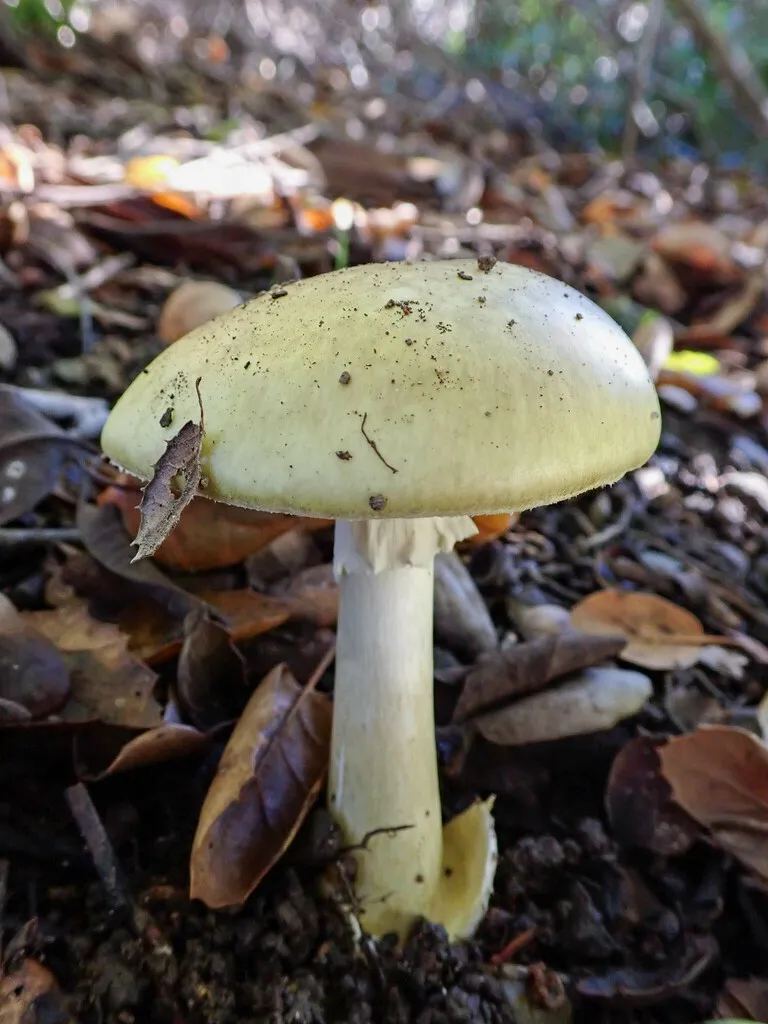
The death cap and the destroying angel differ mainly in cap colour: the death cap is olive, yellow-green or bronze, usually darker in the centre; the destroying angel is pure white all over. Everything else that matters is the same. Both have white gills that are free from the stem, a skirt-like ring high on the stem, and a large white sack (the volva) around the base, which is often buried. Both contain amatoxins, and both kill.
So the real job is not to tell these two apart. It is to recognise either one before it is mistaken for something edible. Check the gills, the ring and the base together, and dig up the base to see the sack. One feature is never enough.
Side by side
| Feature | Death cap (Amanita phalloides) | Destroying angel (A. bisporigera US, A. virosa Europe) |
|---|---|---|
| Cap | 5–15 cm; almost white when young, then yellow, bronze or olive-green, darker at the centre, with faint radiating fibres; smooth, sticky when wet | 2.5–10 cm; "stark white to ivory", smooth, tacky when wet, often with a central bump (US); A. virosa pure white, bell-shaped to flat |
| Gills | White, free, broad, crowded; cream or faintly pink with age | White, free or nearly free, crowded |
| Ring | Fragile, pendant skirt, usually persisting | Thin, high, skirt-like, persistent (US); fragile, ungrooved, high on the stem (Europe) |
| Stem and base | 7–15 cm, off-white with faint zig-zag mottling, swollen base in a "large white, sack-like volva", often greenish inside | 5.5–14 cm, white, somewhat shaggy or cottony; large white sack at the base, "usually buried deep in the soil" |
| Flesh when cut | White | White; A. bisporigera turns bright yellow with KOH (Kuo) (a lab test, not a field one) |
| Smell | Virtually none when young; "sickly sweet" and rancid when old | Faint, sickly, easy to miss outdoors |
| Spore print | White | White |
| Substrate and habit | On the ground, mycorrhizal with hardwoods, especially oak and beech; scattered or in widely spaced groups | On the ground, with oaks and other hardwoods; also in grass near trees (MDC) |
| Season | UK and Europe: July–November; California: "especially abundant in the early wet winter months" (CDC) | US: June–November (Missouri); UK: August–November; northern Europe: July–September |
| Range | Native to Europe; introduced to North America, Australia and South America; "fairly common in most parts of the UK" (Woodland Trust) | A. bisporigera: eastern North America from Texas to the maritime provinces; A. virosa: Britain, Ireland, Scandinavia; "not found in the United States" (MDC) |


What they are mistaken for
This pair causes deaths not because people confuse them with each other, but because both pass for edible mushrooms.
- Field, meadow and horse mushrooms (Agaricus). The classic mix-up. Agaricus has no volva, and its gills start pink or grey-brown and darken to chocolate; a young Amanita's gills are pure white (First Nature, MDC). See meadow mushroom vs destroying angel.
- Puffballs. At the egg stage both Amanitas are a white ball. Cut it lengthwise: an Amanita egg shows the outline of a cap, gills and stem inside; a puffball is solid white. See puffball vs young Amanita.
- Paddy straw and other volva-bearing mushrooms (Volvariella, Volvopluteus). They also sit in a sack, but they have no ring, a pink spore print and gills that turn pink with age (MushroomExpert). An Amanita's gills stay white and its print is white.
- Other Amanitas. MDC says plainly that "other amanitas look similar". Unless you are expert in the genus, treat every Amanita as off limits.
Features that do not separate them from edibles
- Colour. Death caps can be nearly white when young; a pale death cap and a destroying angel are easily confused, and both look like a white Agaricus from above.
- Smell and taste. Young specimens of both are nearly odourless. Never taste either; First Nature notes that even a small amount can be fatal.
- Where it grows. Both grow in woods and at woodland edges, and the destroying angel also appears "in grass near trees" (MDC), the same places people pick field mushrooms.
- The ring on its own. Other mushrooms carry a ring too. The ring plus white gills plus a sack-like base is the combination to fear.
- Insect damage, slug damage, animals eating it. None of these show that a mushroom is safe for people.
Dig, do not pick. The volva is the feature that separates an Amanita from an Agaricus, and it is usually under the soil. Lift the whole base with a knife or your fingers. A photo of a snapped-off stem cannot show it.
What happens if you get it wrong
Both mushrooms contain amatoxins. NAMA describes four stages. First, a latency of "6 to 24 hours after ingestion" with no discomfort while the toxins work on the liver and kidneys. Second, a gastric phase of about 24 hours of "violent vomiting, bloody diarrhea, and severe abdominal cramps". Third, an apparent recovery of about a day, in which patients are sometimes sent home. Fourth, relapse, when "kidney and liver failure often occurs, leading to death". First Nature gives the first symptoms at five to twelve hours and the false recovery lasting "hours or a day or two".
The 2016 California cluster described by the CDC shows the scale: 14 death cap poisonings in one month, most with symptoms 4 to 12 hours after the meal, three liver transplants, and one child with permanent neurological impairment. The report states that "the amanitins are heat stable and are not inactivated by cooking".
Because the delay hides the danger, anyone who may have eaten a white-gilled mushroom with a ring should get help before symptoms start, and keep a piece of the mushroom for identification. The emergency numbers are in the box above. The full species pages cover each mushroom in detail: death cap and destroying angel.
Using an app to check a find
A photo of the cap can show the olive tint of a death cap or the pure white of a destroying angel, and a photo of the underside can show white gills and a ring. It cannot show the volva unless you dig the base and photograph it, and it cannot tell a white Agaricus button from a young Amanita with confidence. Mycoscout's guided capture asks for the cap, the gills, the stem with its base and the habitat for this reason, puts the verdict first, shows its confidence, and names the look-alikes to rule out. A deadly verdict means stop. An edible verdict on a white mushroom with a ring means dig the base and check again, then ask a local expert. Mycoscout is a field companion, not a clearance to eat.
Frequently asked questions
Which is more poisonous, death cap or destroying angel?
Both contain the same amatoxins and both have killed people. Sources do not rank them for a forager's purposes, because either one can be fatal. Treat any white-gilled mushroom with a ring and a sack at the base as deadly.
Can you touch a death cap or destroying angel?
The toxins act when eaten. Handling a specimen to identify it is how field mycologists work. Wash your hands afterwards and never let a piece reach food, children or pets.
How long after eating a death cap do symptoms start?
NAMA gives a latency of 6 to 24 hours before violent vomiting, diarrhea and cramps begin. First Nature gives 5 to 12 hours. The CDC's 2016 California cluster reported onset about 4 to 12 hours after the meal. A false recovery follows, then liver and kidney failure.
Does cooking destroy the toxins in death caps?
No. The CDC report states the amanitins are heat stable and are not inactivated by cooking. First Nature says freezing does not reduce them either.
Sources
How we checked this page: the Mycoscout team cross-checked every edibility, toxicity and look-alike statement against the sources below on October 31, 2026. It has not been reviewed by a mycologist.
- Amanita phalloides, Deathcap, First Nature. Accessed October 31, 2026.
- Amanita virosa, Destroying Angel, First Nature. Accessed October 31, 2026.
- Destroying Angel (Amanita bisporigera), Missouri Department of Conservation. Accessed October 31, 2026.
- Deathcap, Woodland Trust. Accessed October 31, 2026.
- Mushroom poisoning syndromes, North American Mycological Association. Accessed October 31, 2026.
- Amanita phalloides Mushroom Poisonings, Northern California, December 2016 (MMWR 66:549-553), Centers for Disease Control and Prevention. Accessed October 31, 2026.
- Amanita bisporigera, MushroomExpert.com. Accessed October 31, 2026.
