 Mycoscout
The short answer
Cut every puffball in half from top to bottom before it goes in the basket. MDC's instruction is exact: "make sure you cut through any puffball from top to bottom" to confirm it is "pure white inside, like a marshmallow, with no sign of a cap or stem". A young Amanita, at the stage foragers call an egg, is also a smooth white ball on the ground, and the cut shows the difference at once: the folded outline of a cap, a layer of gills and a stem, all inside a white skin. First Nature says it for both the death cap and the destroying angel: at the button stage they resemble young puffballs, and "cutting the fruitbody lengthwise reveals the volva".
A puffball that is yellow, olive or brown inside is too old to eat. A puffball with anything other than uniform white inside is not a puffball. Then check the rest: the skin, the base, the size and what else is growing nearby, because one feature is never enough.
Side by side
| Feature | Giant puffball (Calvatia gigantea) | Young Amanita (egg stage) |
|---|---|---|
| Shape and size | Round or slightly flattened ball; 8–20 in (MDC), 10–80 cm (First Nature), "as big as a soccer ball or even much larger" | Egg-shaped to round, a few centimetres across; a death cap cap grows to 5–15 cm, so the egg is far smaller than a mature giant puffball |
| Surface | White, smooth to leathery, "cracking irregularly" with age; no stem | White, smooth, sometimes with patches; no visible stem yet |
| Inside when cut | Uniform pure white, marshmallow-like; turns yellowish green, olive, then brown as the spores ripen | A miniature mushroom folded inside a skin: cap dome, gills, stem, sitting in a sac. First Nature: cutting lengthwise "reveals the volva" |
| Base | A root-like cord of mycelium; "next to no sterile base" (First Nature) | A sac-like cup (volva) that will stay around the stem base, often buried |
| Flesh when cut | White, firm, no structure | Structured: layers and an outline |
| Smell | Not a field test | Virtually odourless when young (First Nature) |
| Spore print | Not possible until it matures; spore mass olive-brown | White, once the cap opens |
| Substrate and habit | Pastures, lawns, field edges, road verges, nettle beds, woodland edges; singly or in small groups, sometimes in rings | On the ground under or near trees, often oak and beech; destroying angel also "in grass near trees" (MDC) |
| Season | US: May–October; UK: July–November | Summer and autumn: death cap July–November in the UK; destroying angel June–November in Missouri |
| Range | Localised in Britain and Ireland, common in parts of Europe and North America | Death cap: Europe, introduced to North America; destroying angels: eastern North America (A. bisporigera), Europe (A. virosa) |
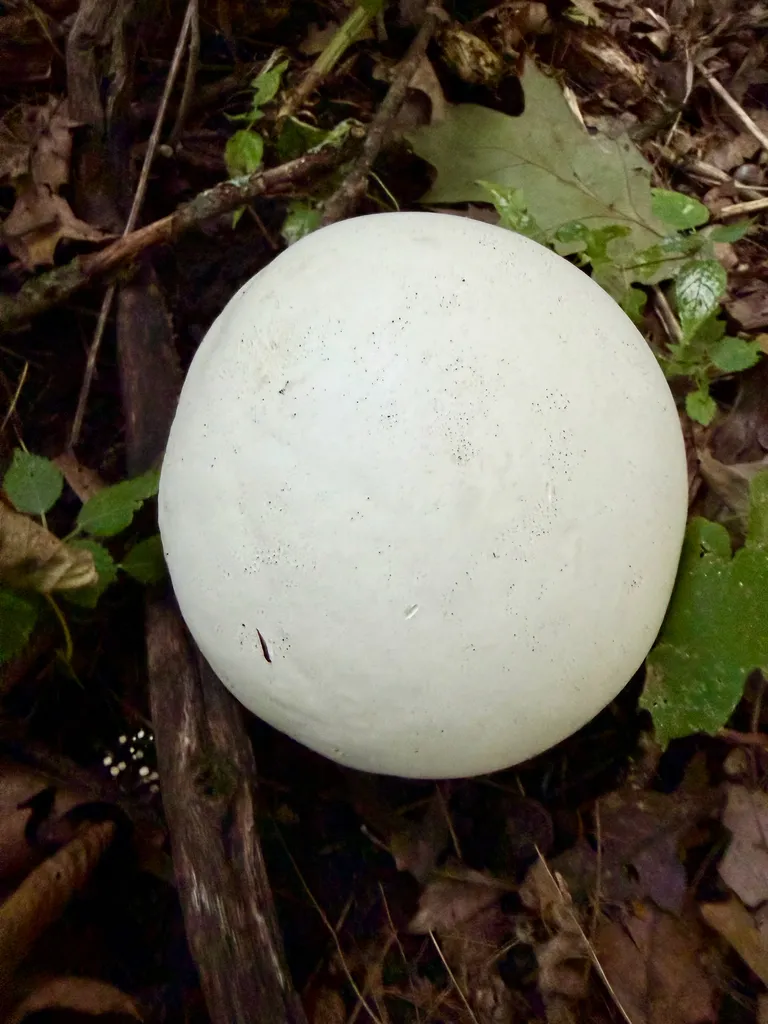
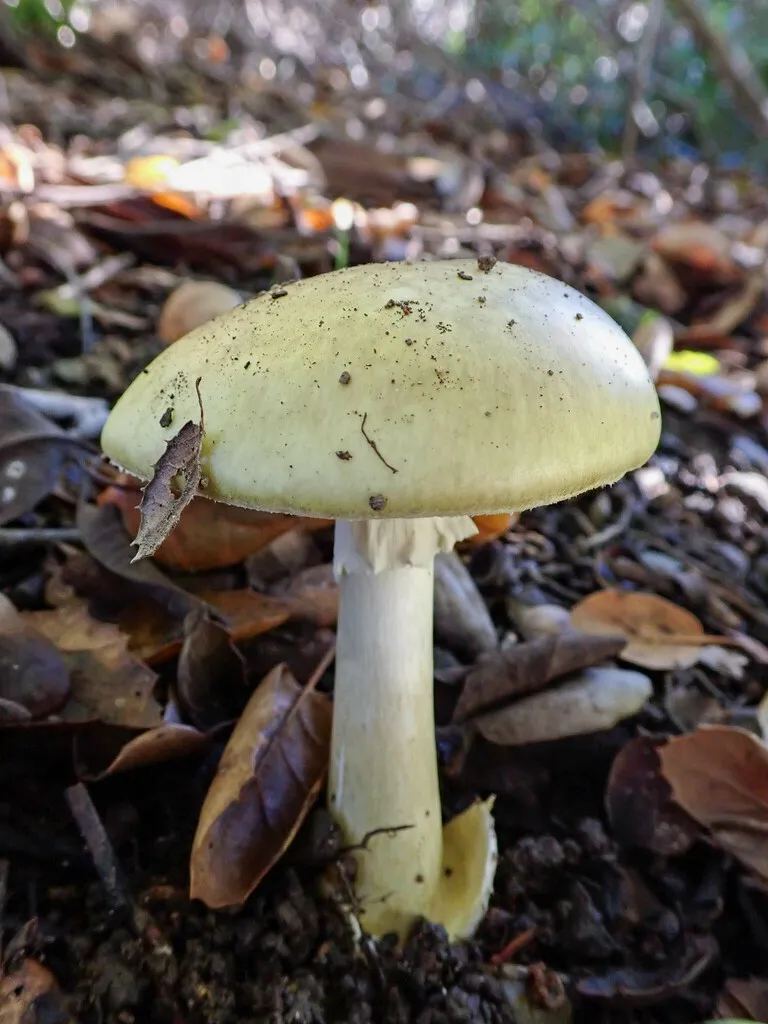

We have no licensed photo of an Amanita egg cut in half, so here is the picture in words. Hold the white ball with its base down and slice straight through from top to bottom. A puffball is one white block from skin to skin, like cutting a marshmallow. An Amanita egg is a white outer skin a few millimetres thick, then a hollow or gap, then a small domed cap with a row of pale gills beneath it, and a short stem below that, standing in the cup formed by the skin. The pieces are the mushroom that would have opened a day or two later.
Features that do not separate them
- White outside. Both are white. Both can be smooth. Dirt, slug damage and cracks appear on both.
- Size, except at the extremes. A giant puffball the size of a football cannot be an Amanita egg. A puffball the size of a golf ball can be, and the common smaller puffballs (Lycoperdon) sit right in the Amanita egg size range. Every small puffball gets the cut.
- Growing in grass. Giant puffballs grow in pastures and lawns; the destroying angel grows "in grass near trees" (MDC). A lawn with trees at the edge can hold both.
- No stem visible. An Amanita egg has no stem visible either; the stem is inside the skin.
- Season. Both fruit from summer into autumn.
- Squeezing it. Both feel firm when young. Pressure tells you nothing the knife does not tell you better.
Two other white-ball mistakes: earthballs (Scleroderma) are tougher-skinned and purple-black inside when cut; see earthball vs puffball. And a puffball that was white last week can be olive and powdery today, which is why First Nature says a giant puffball is edible only while "fresh and white throughout".
What happens if you get it wrong
An Amanita egg contains the same amatoxins as the mature mushroom. NAMA's amatoxin syndrome runs in four stages: a latency of "6 to 24 hours after ingestion" with no symptoms while the toxins damage the liver and kidneys; about 24 hours of "violent vomiting, bloody diarrhea, and severe abdominal cramps"; an apparent recovery of about a day, during which patients may be sent home; then relapse with "kidney and liver failure often occurs, leading to death". First Nature puts the first symptoms at five to twelve hours and says that when they return after the false recovery, liver and kidney damage is already advanced. First Nature says that cooking does not reduce the toxin.
An egg sliced into a pan with real puffballs is invisible once cooked. If a batch of "puffballs" went uncut and someone has eaten them, do not wait for symptoms; keep a piece if any remains and get help now. The numbers are in the box above. For the mushrooms themselves, see the death cap and giant puffball pages.
Using an app to check a find
A photo of a white ball on the ground tells an app almost nothing, and that is the honest answer. Mycoscout will put a verdict first and show its confidence, and it names the young Amanita and the earthball as look-alikes to rule out, with the lengthwise cut as the feature to check yourself. The cut surface is the photo worth taking: uniform white on one side, a folded mushroom on the other, and the app can read that. Treat an "edible" verdict on an uncut ball as a prompt to cut it, not as a result. iNaturalist and a local mycological society are good free second opinions. No app, this one included, clears a mushroom for eating.
Frequently asked questions
How can you tell if a puffball mushroom is edible?
Cut it from top to bottom. MDC says a puffball you can eat is pure white inside like a marshmallow, with no sign of a cap or stem. Yellow, olive or brown inside means it is too old; any mushroom outline inside means it is not a puffball at all. Then confirm the species with a local expert.
What does a young Amanita look like inside?
Cut lengthwise, an Amanita egg shows a developing mushroom folded inside a white skin: the dome of a cap, a layer of gills, and a short stem sitting in the sac (the volva). First Nature says cutting the fruitbody lengthwise reveals the volva. A puffball shows none of this.
Can a giant puffball be confused with a death cap?
A mature giant puffball is too large to confuse with anything, but small or young puffballs and the egg stage of death caps and destroying angels are both white balls on the ground. MDC names the destroying angel as a puffball look-alike; First Nature names young puffballs as a look-alike of both the death cap and the destroying angel.
Is the earthball also a look-alike?
Yes. Earthballs (Scleroderma) are tough-skinned, often yellowish, and purple-black inside when cut. They are poisonous. They are covered on the earthball vs puffball page.
Sources
How we checked this page: the Mycoscout team cross-checked every edibility, toxicity and look-alike statement against the sources below on October 31, 2026. It has not been reviewed by a mycologist.
- Giant Puffball (Calvatia gigantea), Missouri Department of Conservation. Accessed October 31, 2026.
- Calvatia gigantea, Giant Puffball, First Nature. Accessed October 31, 2026.
- Amanita phalloides, Deathcap, First Nature. Accessed October 31, 2026.
- Amanita virosa, Destroying Angel, First Nature. Accessed October 31, 2026.
- Destroying Angel (Amanita bisporigera), Missouri Department of Conservation. Accessed October 31, 2026.
- Mushroom poisoning syndromes, North American Mycological Association. Accessed October 31, 2026.
