 Mycoscout
The short answer
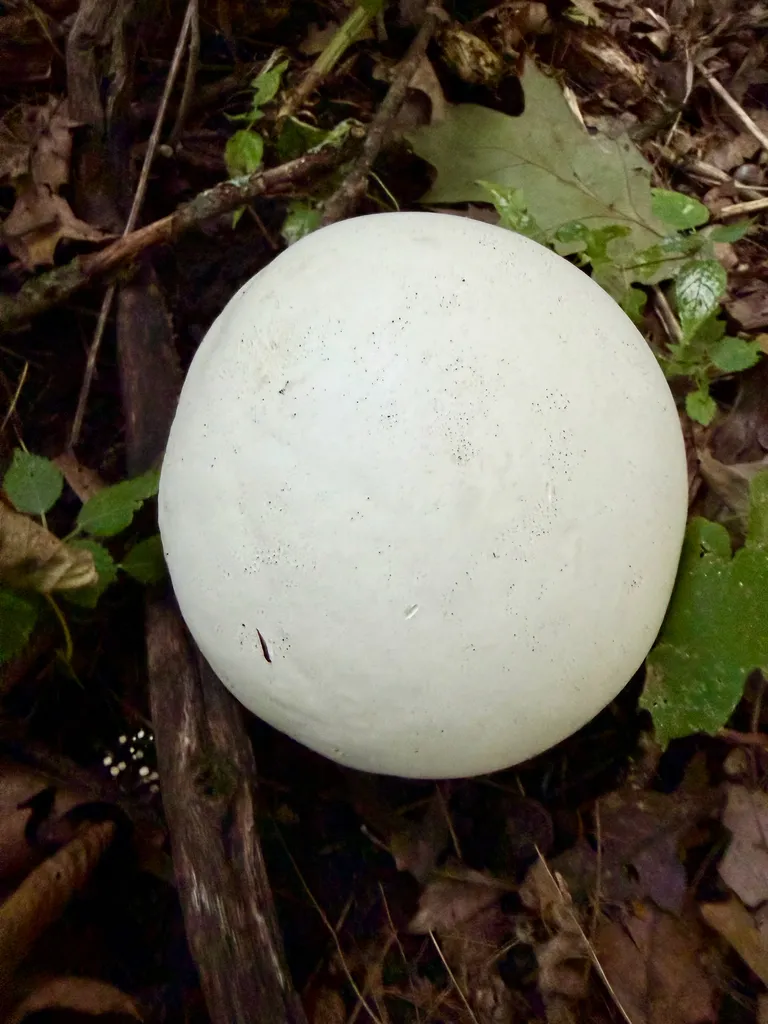
Press it, then cut it. A common earthball (Scleroderma citrinum; pigskin poison puffball in the US) is hard, has a thick leathery rind covered in coarse scales, and is purple-grey to black inside long before it is ripe. A giant puffball (Calvatia gigantea) is soft like a marshmallow, has a skin under 1 mm thick, and is pure white and uniform inside when it is fit to eat; it turns yellow-olive then brown as the spores ripen, and is then inedible. Earthballs split open irregularly; most true puffballs open through a pore at the top, though the giant puffball's skin simply cracks and flakes away.
Those are the rules. Their limit is age: a very young earthball is still whitish inside, so firmness and the rind matter as much as color. Check all three, not one.
Side by side
| Feature | Common earthball | Giant puffball |
|---|---|---|
| Size | 2–5 cm (Kuo); 4–12 cm across, 3–6 cm tall (First Nature, Woodland Trust) | 10–80 cm, typically soccer-ball sized; 8–20 in (MDC); records over a meter |
| Skin | Thick, tough, leathery rind 1–3 mm; dirty yellow to ochre-brown; coarse irregular scales; may crack | Thin, under 1 mm; white, smooth to lumpy or finely velvety; cracks and sloughs with age |
| Feel | Hard, firm | Spongy, marshmallow-like |
| Interior when young | Whitish, soon marbled, then purple-grey to purple-black with white veins while still solid | Pure white, uniform, no structure |
| Interior when old | Blackish to dark brown powder | Yellowish olive, then brown powder |
| Base | No stem; white mycelial threads | No stem, no sterile base; a short root-like cord |
| Smell | Unpleasant, rubbery or gas-like | Not distinctive when fresh |
| How it opens | Rind ruptures into a large irregular hole | Skin cracks and flakes; the ball often breaks free and rolls |
| Habitat | Acid, sandy or peaty soil, mossy banks, compacted woodland paths; mycorrhizal with oaks and other hardwoods | Verges, field edges, nettles and rank vegetation, meadow edges, open woods, lawns; saprobic |
| Season | July to December (UK); July to October (Missouri); summer and fall | July to November (UK); May to October (Missouri); late summer and fall |
| Range | Europe and North America | Europe; North America mainly from the Great Plains east |


Features that do not separate them
- It is round and has no gills. So is an Amanita egg, and so are stinkhorn eggs. "No gills" is not an identification.
- White on the outside. Young earthballs can be whitish to cream (First Nature). Color of the skin is weaker than its thickness and texture.
- Growing on the ground in a wood. Both can. Earthballs favor acid, compacted and mossy ground; puffballs favor rich grassy edges. Habitat narrows it, nothing more.
- Small size means earthball. Smaller true puffballs (Lycoperdon) exist in the same woods and are white inside when young. Size alone separates nothing.
- A white interior. A very young earthball can still be whitish. MDC says it darkens with age; First Nature says it is almost white at first. Pair the color with the rind and the feel.
Every puffball you intend to eat must be cut top to bottom. MDC says it should be entirely smooth and plain throughout, with no sign of a cap or stem. Any outline of a mushroom inside means an Amanita egg; the puffball vs amanita page covers that, and it is the mistake that kills.
What happens if you get it wrong
MDC lists the common earthball as poisonous, causing upset stomach, nausea and vomiting, and says the related potato earthball (S. bovista) causes severe gastric upset. The Woodland Trust says it causes many UK poisonings each year and is not described as deadly. First Nature reports conflicting accounts and settles on "at best inedible and suspect and at worst poisonous". NAMA's general figure for gastrointestinal irritants is onset 20 minutes to 4 hours, with symptoms that pass once the irritant is gone and severe cases needing fluids in hospital.
A puffball that has gone yellow or brown inside is not poisonous in the sources we read, but First Nature and MDC both call it inedible at that stage.
Using an app to check a find
A photo of the skin can show scales and color, and a photo of the cut face can show rind thickness and interior color, so cut before you photograph. An uncut ball photographed in the grass is close to useless for this pair. Mycoscout leads with the edibility verdict, shows its confidence, and names the earthball and the Amanita egg as look-alikes with the checks to make in hand. It is not a clearance to eat. A local mycological society can look at the specimen itself; the what mushroom is this guide lists the free routes.
Frequently asked questions
How do you tell an earthball from a puffball?
Cut it top to bottom. An earthball has a thick, tough rind, 1 to 3 mm, and an interior that is already purple-grey to black while the ball is hard. A puffball has a skin under 1 mm, feels spongy, and is pure white inside when young. Any marbling, purple or black means do not eat.
Is the common earthball poisonous?
MDC and the Woodland Trust list it as poisonous, causing upset stomach, nausea and vomiting. First Nature calls it at best inedible and at worst poisonous. No source we read calls it deadly.
Can a puffball be something worse than an earthball?
Yes. A young Amanita egg, including the destroying angel, is a white ball in grass near trees. Cut lengthwise it shows the outline of a cap, gills and stem inside. A true puffball is uniform white with no structure.
Can you eat an earthball if you cook it?
No source we read says cooking makes it edible, and both MDC and the Woodland Trust list it as poisonous as a species.
Sources
How we checked this page: the Mycoscout team cross-checked every edibility, toxicity and look-alike statement against the sources below on October 31, 2026. It has not been reviewed by a mycologist.
- Scleroderma citrinum, Common Earthball, First Nature. Accessed October 31, 2026.
- Calvatia gigantea, Giant Puffball, First Nature. Accessed October 31, 2026.
- Pigskin Puffball (Common Earthball), Missouri Department of Conservation. Accessed October 31, 2026.
- Giant Puffball (Calvatia gigantea), Missouri Department of Conservation. Accessed October 31, 2026.
- Common earthball, Woodland Trust. Accessed October 31, 2026.
- Scleroderma citrinum, MushroomExpert.com (Michael Kuo). Accessed October 31, 2026.
- Calvatia gigantea, MushroomExpert.com (Michael Kuo). Accessed October 31, 2026.
