 Mycoscout
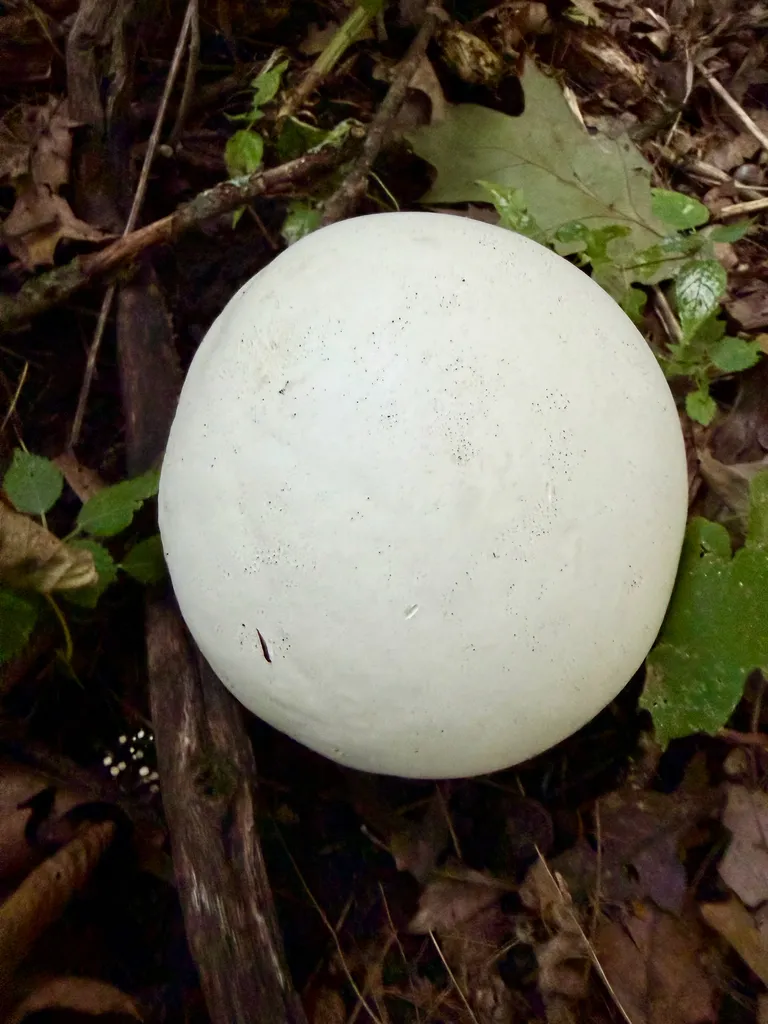
How to identify a giant puffball
The giant puffball is hard to miss: a white, roughly round fungus the size of a football or larger, sitting on grass with no stem and no cap. First Nature gives a typical width of 10 to 80 cm; the Missouri Department of Conservation (MDC) gives 8 to 20 inches and notes specimens of 25 pounds or more. The problem is never the full-grown giant. It is the fist-sized white ball that could be a young puffball, a young death cap or destroying angel still inside its egg, or an earthball.
| Feature | Giant puffball (Calvatia gigantea) |
|---|---|
| Fruit body | Round or slightly flattened ball, no stem, no cap. 10–80 cm across (First Nature); 20–30 cm or more (MushroomExpert.com). Skin white, smooth to finely velvety, leathery, cracking with age; less than 1 mm thick. |
| Gills / underside | None. A short, thick cord may attach the base to the ground. |
| Stem & base | No stem and almost no sterile base; the whole interior is spore mass. |
| Flesh | Pure white and uniform when young, firm and marshmallow-like. Turns yellowish, then olive, then brown powder as spores ripen. |
| Spore print | Olive-brown (First Nature); greenish brown (MDC). The ripe interior is the "print". |
| Smell | Faint and pleasant (First Nature); not distinctive (MushroomExpert.com). |
| Habitat | Roadside verges, field edges, nettles and rank vegetation on rich ground, open woodland and clearings, lawns and pastures. Singly or in small groups, sometimes in rings. |
| Season | July–November in Britain and Ireland. Late summer and early fall in North America; May–October in Missouri. |
| Range | US: fairly widely distributed from the Great Plains eastward; western records are doubtful (MushroomExpert.com). UK & Europe: widespread but localised and infrequent; across mainland Europe. |
Confirm these features
- Cut the whole thing in half from top to bottom. The cut face must be solid white and uniform all the way through, like a marshmallow.
- No outline of a cap, stem or gills inside, however faint. Destroying angel eggs are white inside too, so the outline is harder to see: look closely in good light.
- No dark, purple, grey or marbled zone in the middle, which points to an earthball.
- Skin thin, about as thin as an eggshell, not a thick firm rind.
- No stem below the ball and no sac or cup at the base when you lift it.
- Growing on the ground in grass or at a woodland edge, not on wood.
Why one feature is never enough: a white ball in grass is the shape of three different fungi. Size helps only once the puffball is far bigger than any Amanita egg; a small puffball offers no such help. Treat the cut test as a minimum, not a guarantee, and check every feature above on every specimen, not on one from the group.
Dangerous look-alikes
Death cap and destroying angel eggs (Amanita phalloides, A. bisporigera, A. virosa)
Tell apart: Amanita species emerge from a white egg wrapped in the universal veil. First Nature states that a death cap at the button stage could be mistaken for an edible puffball and that cutting it in half lengthways shows the volva at once. Inside the egg you will see the shape of a developing mushroom: a cap, a stem, and gills folded against it. A true puffball shows none of that. The full comparison is on the puffball vs amanita page.
Risk: deadly. Amatoxins. The North American Mycological Association (NAMA) describes a delay of 6 to 24 hours before symptoms, then severe diarrhea and vomiting, an apparent recovery, and liver and kidney damage. The UBC Beaty Museum states plainly that death and serious illness have resulted from eating egg stages of a death cap after mistaking them for puffballs.
Earthballs (Scleroderma citrinum and relatives)
Tell apart: an earthball is firm, not marshmallow-soft; UBC says press it and the difference is obvious. Its rind is about 2 mm thick against the eggshell-thin puffball skin, and the skin is yellow-brown and coarsely scaly like a warty potato. Cut, the interior is white only very briefly and soon turns purple-grey to black with white marbling. See the earthball page and earthball vs puffball.
Risk: poisonous. Gastrointestinal irritant; symptoms within minutes to a few hours. Not reported as deadly, but UBC lists serious illness from earthballs eaten as puffballs.
Smaller puffballs (Lycoperdon and Bovista species)
Tell apart: pear-shaped or club-shaped with a small sterile base, often with pearly spines or scales, usually under 10 cm. First Nature lists the common puffball (Lycoperdon perlatum) as edible when white inside, with the same rule: discard any that have started turning yellow, olive or brown.
Risk: these are not the danger; the danger is that a small white ball you take for a small puffball is in fact an Amanita egg. The cut test applies to every one of them.
Where and when it grows
The giant puffball is a saprobe on dead organic matter. In Britain and Ireland First Nature lists roadside verges, field edges and ground thick with briars and nettles, occasionally open woodland, from July to November; Kent Wildlife Trust adds grass verges and field and woodland edges and calls it widespread but localised. In North America MushroomExpert.com describes it growing alone or in groups in woods or grass, often at meadow edges, in drainage ditches or under brush, in late summer and early fall, mainly from the Great Plains eastward. MDC lists pastures, woods and lawns from May to October across Missouri. It can come back in the same spot for years.
Before you eat any
Every source here puts conditions on the edible verdict. Only gather puffballs that are fresh and white right through; once the flesh discolours it is inedible (First Nature, UBC). MDC advises peeling the tough outer skin, cooking thoroughly, and trying only a small amount the first time because some people react to fungi they have not eaten before. First Nature warns against specimens from busy roadsides because of exhaust contamination, and MDC adds lawns treated with chemicals. None of this is a clearance to eat. Take a cut specimen to a local mycological society or an experienced forager and confirm it in person; the how to tell if a mushroom is poisonous guide explains why a single rule is never enough.
Using an app to check a find
A photo of a white ball in the grass tells an app its shape, size relative to the grass, skin texture and setting. It cannot tell the app what the inside looks like, which is the one feature that separates a puffball from an Amanita egg. Mycoscout leads with the edibility verdict, shows how confident it is, and lists the look-alikes to rule out, including young Amanita eggs and earthballs, so you know what to cut and check. It is a field companion, not a clearance to eat. For a second free opinion, iNaturalist lets human identifiers comment on your photos, and a local mycological society can look at the specimen itself.
Frequently asked questions
How can you tell if a puffball mushroom is edible?
No single test does. Cut it in half from top to bottom: the inside must be pure white and uniform, with no outline of a cap, stem or gills and no thick rind; yellow, olive or brown inside means it is past eating. Then confirm the find in person with a local expert before you eat any.
What does a giant puffball look like inside?
Fresh and young, the interior is solid white right through, like a marshmallow, with almost no sterile base. As the spores ripen it turns yellowish, then olive, then brown powder. The outer skin is thin, less than 1 mm according to MushroomExpert.com.
Can a giant puffball be poisonous?
A true giant puffball that is white throughout is listed as edible by First Nature and the Missouri Department of Conservation. The danger is a different fungus mistaken for one: the egg of a death cap or destroying angel, which is deadly, or an earthball, which is poisonous. The UBC Beaty Museum notes that deaths and serious illness have followed exactly this mistake.
When do giant puffballs grow?
July to November in Britain and Ireland (First Nature); late summer and early fall in North America (MushroomExpert.com), with Missouri records from May to October. They grow on verges, field edges and in grass, often in small groups.
Sources
How we checked this page: the Mycoscout team cross-checked every edibility, toxicity and look-alike statement against the sources below on October 31, 2026. It has not been reviewed by a mycologist.
- Calvatia gigantea, Giant Puffball, First Nature. Accessed October 31, 2026.
- Giant Puffball (Calvatia gigantea), Missouri Department of Conservation. Accessed October 31, 2026.
- Calvatia gigantea, MushroomExpert.com (Michael Kuo). Accessed October 31, 2026.
- Lycoperdon pyriforme, Pear-shaped puffball (puffball safety notes), Beaty Biodiversity Museum, University of British Columbia. Accessed October 31, 2026.
- Scleroderma bovista, Potato earthball (earthball vs puffball), Beaty Biodiversity Museum, University of British Columbia. Accessed October 31, 2026.
- Amanita phalloides, Deathcap, First Nature. Accessed October 31, 2026.
- Mushroom poisoning syndromes, North American Mycological Association. Accessed October 31, 2026.
- Giant puffball, Kent Wildlife Trust. Accessed October 31, 2026.
