 Mycoscout
The short answer
Cut it in half from top to bottom. A true morel is hollow all the way through: one open space runs from the tip of the cap to the base of the stem, and the pitted cap is fused to the stem along its lower edge. A false morel (Gyromitra) has a cap that bulges outward in lobes, folds and wrinkles rather than pitting inward, and inside it is divided into irregular chambers, with a stem that holds several tube-like hollows or cottony tissue.
That one cut separates most finds. It is still not enough on its own. Check every feature below, because a Verpa (a third spring look-alike) is also hollow in the cap, and colour alone will mislead you.
Side by side
| Feature | Morel (Morchella) | False morel (Gyromitra) |
|---|---|---|
| Cap | Conical to egg-shaped, covered in pits separated by ridges; looks like a honeycomb or sponge | Irregularly lobed, folded and wrinkled, "rather like a brain" (First Nature); usually broader than tall |
| Cap edge | Fused to the stem (half-free morels hang free for the lower half of the cap) | Lobes hang loose around the stem |
| Colour | Yellow-tan, grey to brown; black morels have dark ridges | Red-brown to chestnut; G. caroliniana has a deep reddish wrinkled cap |
| Inside when cut | One continuous hollow chamber, cap and stem together | Cap folded into irregular hollow chambers; stem with several tube-like hollows |
| Stem | White or pale cream, hollow, often widest at the base | Creamy white, short and thick, fragile |
| Smell | Not distinctive | Not distinctive |
| Spore print | Creamy white to pale ochre | Not useful in the field |
| Habitat | On the ground in moist woods and river bottoms; near ash, dying elm, apple and under conifers (MDC); chalky soil under deciduous trees in Britain (First Nature) | Conifer woods, usually sandy soil under pines (First Nature); in Missouri the big red false morel (G. caroliniana) is the most common species (MDC) |
| Season | US: late March through April in Missouri; UK: March to early June | Spring and early summer |
| Range | Most of North America, Europe, parts of Asia | Europe and many parts of North America |
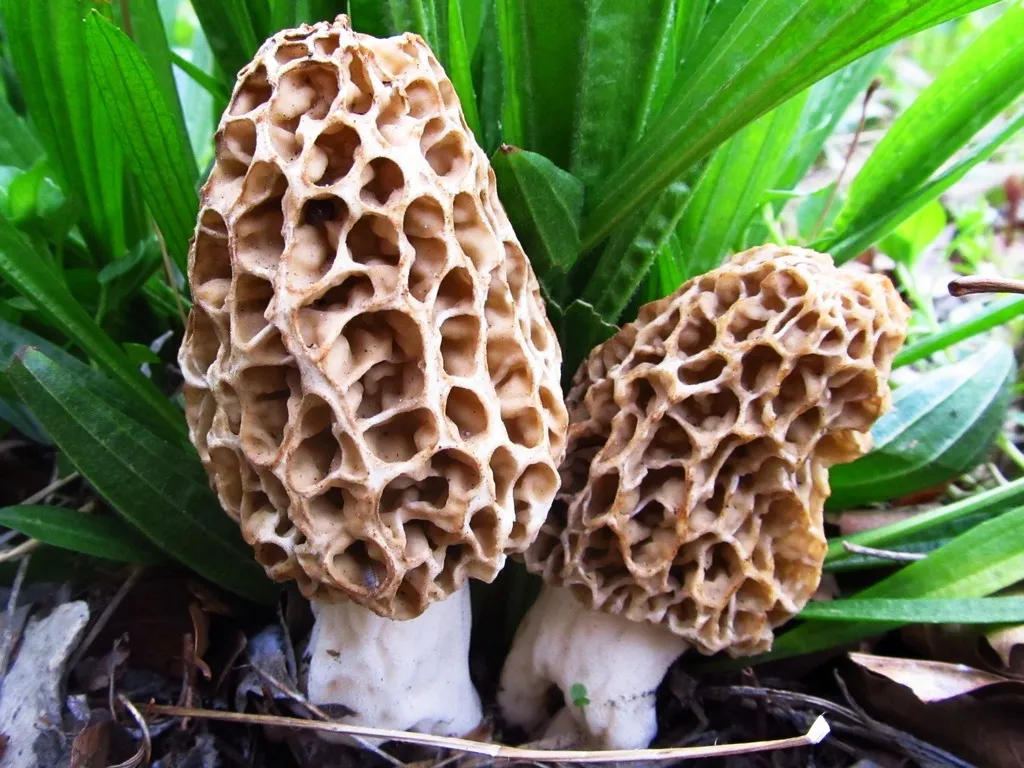
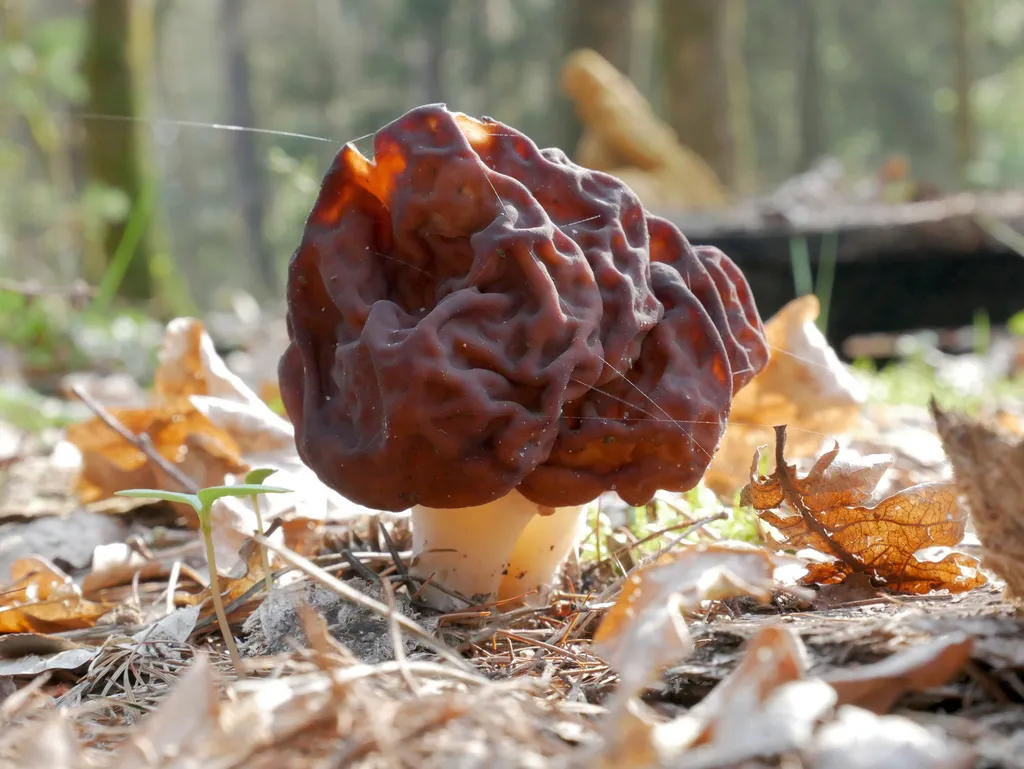
Neither photo shows the inside. Take the knife to every find.
The third confusion: Verpa
Verpa bohemica (the early false morel, or wrinkled thimble-cap) fruits very early in spring and keeps going into the true morel season. Its cap is wrinkled lengthwise rather than pitted, and it hangs completely free of the stem, attached only at the very top, like a thimble on a finger. Half-free morels are "exactly that, half-free" (MushroomExpert): the lower half of the cap hangs loose, the upper half is attached. Cut a Verpa and the stem is "loosely stuffed with whitish, wispy fibers (like cotton candy)", not clean and hollow. Treat it as a separate mushroom, not a morel.
Features that do not separate them
- Colour. Morels run from yellow to grey to black. False morels run from tan to deep red-brown. The ranges touch. Do not sort by colour.
- Size. Both groups produce small and large fruit bodies in the same wood.
- Habitat. Both grow on the ground in spring, sometimes a few metres apart. Morels near elms and false morels near pines is a tendency, not a rule.
- "It looks spongy." A false morel's folds can read as "pitted" in a quick glance or a dim photo. Pits go inward; lobes bulge outward. Hold it in the light and look.
- "Locals eat them." Some regions have a tradition of eating false morels after special preparation. First Nature says toxicity varies by location, that "cooking is not a guarantee of safety", and that toxin can build up over repeated meals. We do not describe any preparation method.
Why one feature is never enough: a Verpa is hollow in the cap, a half-free morel hangs loose like a Verpa, and an old false morel can collapse into something that looks pitted. Match the cut, the cap attachment and the cap surface together before you decide, and then confirm with someone local who knows the genus.
What happens if you get it wrong
False morels contain gyromitrin, which the body converts to monomethylhydrazine (MMH). NAMA says symptoms appear "within 2 to 24 hours": headache, abdominal distress, severe diarrhea and vomiting. In severe cases "liver, kidney, and red blood cell damage may occur, possibly resulting in death". First Nature adds that the early signs include stomach pain, sweating and vomiting, that the toxin affects the central nervous system, and that death, when it happens, typically follows "five days to a week after eating the fungi". NAMA warns there is no reliable safe amount.
The delay matters: a person who ate false morels at dinner may feel fine at bedtime. If someone has eaten a mushroom they thought was a morel and you are not certain, do not wait for symptoms. Keep a piece of the mushroom for identification and get help now (the numbers are in the box above).
True morels are not harmless either. NAMA and First Nature both say raw or undercooked morels cause stomach upset, so the morel species page covers cooking caveats. Our false morel page covers Gyromitra in more detail.
Using an app to check a find
A photo of a morel shows the honeycomb cap, the colour and roughly where it grew. It cannot show the inside of the stem, which is the feature that decides this pair, and it cannot tell a half-free morel from a Verpa unless you photograph the cut surface. Mycoscout leads with the verdict, shows its confidence, and names the false morel and Verpa as look-alikes to rule out, with the features to check yourself. Photograph the mushroom whole and then cut lengthwise, and compare both halves with the table above. If the app says "likely morel" and the stem is stuffed with cotton, the stem wins. Free routes work too: iNaturalist adds human identifiers over time, and a local mycological society foray is the most reliable check. No app, this one included, clears a mushroom for eating.
Frequently asked questions
What does a false morel look like cut in half?
A false morel cut lengthwise shows a cap folded into irregular hollow chambers and a stem with several tube-like hollows or cottony tissue. A true morel cut the same way is one clean hollow space from the top of the cap to the bottom of the stem.
Are false morels poisonous?
Yes. Gyromitra species contain gyromitrin, which the body turns into monomethylhydrazine. NAMA reports symptoms within 2 to 24 hours, and severe cases can damage the liver, kidneys and red blood cells and can be fatal. Cooking is not a guarantee of safety.
Can you eat morels raw?
No. First Nature, the Missouri Department of Conservation and the Woodland Trust all say morels must be cooked thoroughly. Raw or undercooked morels cause stomach pain and sickness.
What is a Verpa, and is it a morel?
Verpa bohemica is an early-spring look-alike with a wrinkled, thimble-like cap that hangs free from the stem, attached only at the top. Its stem is loosely stuffed with cotton-candy-like wisps, not clean and hollow. It is not a true morel.
Sources
How we checked this page: the Mycoscout team cross-checked every edibility, toxicity and look-alike statement against the sources below on October 31, 2026. It has not been reviewed by a mycologist.
- Morels, Missouri Department of Conservation. Accessed October 31, 2026.
- Morchella esculenta, Morel, First Nature. Accessed October 31, 2026.
- Gyromitra esculenta, False Morel, First Nature. Accessed October 31, 2026.
- Mushroom poisoning syndromes, North American Mycological Association. Accessed October 31, 2026.
- Verpa bohemica, MushroomExpert.com. Accessed October 31, 2026.
- Morel, Woodland Trust. Accessed October 31, 2026.
