 Mycoscout
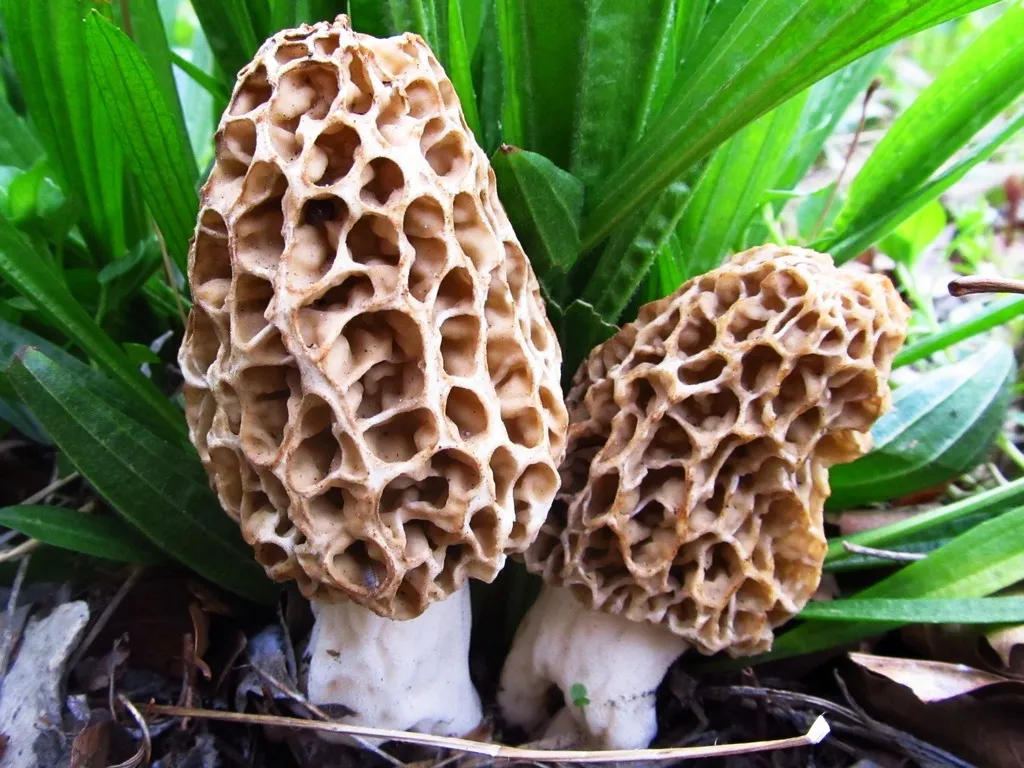
How to identify morel mushrooms
A morel is a spring mushroom whose cap looks like a honeycomb or sponge: a network of pits separated by ridges, in cream, yellow, tan, grey or brown. The cap is fused to a pale, hollow stem, and when you slice the whole thing lengthwise there is one continuous hollow from the top of the cap to the base. No gills, no ring, no sac. Those three things, pitted cap, cap joined to stem, hollow inside, are the identification; every one of them has to be checked on every specimen.
The naming is unsettled. For two centuries most morels were called Morchella esculenta; DNA studies since 2012 show several dozen species, and the European and North American ones that look alike are mostly not the same species. The common eastern US yellow morel was described in 2012 as M. esculentoides and now usually appears under the name M. americana. Some populations cannot be told apart without DNA. For identification this does not matter: all true morels are treated the same way, and all of them must be cooked.
| Feature | Morel (Morchella) |
|---|---|
| Cap | 3–8 cm across and 5–12 cm tall in M. esculenta; M. americana 2.5–11 cm tall, occasionally more. Globe- to egg-shaped or conical. Covered in pits separated by ridges; ridges usually paler than the pits. Cream, ochre, yellow, tan or grey-brown; black morels have dark ridges. The lower edge of the cap is fused to the stem (half-free morels hang free for the lower part, but stay hollow). |
| Gills / underside | None. The inside of the cap is smooth and hollow. |
| Stem & base | 3–12 cm tall, white to cream, often swollen or furrowed at the base, hollow, smooth. No ring, no sac. |
| Flesh | Thin, waxy, brittle. Hollow throughout; one chamber, no cottony filling. Does not bruise red when fresh. |
| Spore print | Creamy white to pale ochre (rarely taken; the cut is the test). |
| Smell | Mild, pleasant, mushroomy. |
| Habitat | On the ground in moist woodland and river bottoms: dead and dying elms, living ash, old apple orchards and other hardwoods in the eastern US; river-bottom hardwoods and planted ash or apple in the West; chalky soil under deciduous trees in Britain. Also disturbed soil and wood-chip beds. |
| Season | Spring only. US: March to June by latitude and altitude; Missouri late March through April. UK and Ireland: March to early June. |
| Range (US / UK & Europe) | Common across North America east of the Rockies, patchier in the West. Infrequent in Britain and Ireland; throughout Europe. |

Confirm these features
- A cap of pits and ridges, like a honeycomb or sponge, not folds, lobes or a brain-like surface.
- The cap is joined to the stem at its lower edge (or, in a half-free morel, hangs free for only its lower part).
- Cut lengthwise: one continuous hollow from cap tip to stem base, with no cottony filling and no chambers.
- No gills under the cap, no ring on the stem, no sac at the base.
- Growing on the ground in spring, not on a tree trunk, and not in autumn.
- Cap colour from cream to brown; a reddish-brown, wrinkled cap is a warning sign.
Why one feature is never enough: a false morel can be tan rather than red, a Verpa has a pale stem and grows in the same woods in the same weeks, and a half-free morel can look as if its cap hangs loose like a Verpa. The lengthwise cut settles most cases; the pitted (not wrinkled) surface and the attachment settle the rest. Do all three, on each mushroom, every time.
Dangerous look-alikes
False morel (Gyromitra esculenta and relatives)
Tell apart: the cap is red-brown to tan and wrinkled, lobed or brain-like, with no honeycomb pits; it bulges outward over the stem. Cut in half, the cap and stem are filled with chambers or cottony tissue, never one clean hollow. Risk: false morels contain gyromitrin, which causes vomiting and diarrhea 2 to 24 hours later and in severe cases liver damage and death. The Missouri Department of Conservation advises treating all so-called false morels as toxic. See morel vs false morel and the false morel page.
Early false morels (Verpa bohemica, V. conica)
Tell apart: the cap is a thimble that hangs free from the stem and is attached only at the very top; the stem is often stuffed with cottony pith rather than clean hollow. A half-free morel hangs free for only the lower half of the cap and is hollow throughout. Risk: Verpa is eaten by some and has made others ill; because the two look so alike in the field, the cut is the only reliable test.
Elfin saddles (Helvella)
Tell apart: a saddle-shaped or lobed cap on a ribbed, grooved stem with internal channels; the cap surface is smooth, not pitted. Risk: listed by Missouri as a morel look-alike; not a mushroom to eat on a guess.
Where and when it grows
Morels fruit in spring and only in spring. In North America they start in the south in March and move north, with Missouri's season running late March through April and the northern states and higher ground into June. East of the Rocky Mountains the classic spots are under dead and dying American elms, living white and green ash, other hardwoods and old untended apple orchards, occasionally under conifers. In the West they favour river-bottom hardwoods and planted ash or apple in towns. In Britain and Ireland M. esculenta is infrequent, found on chalky soil under deciduous trees and sometimes on disturbed garden soil, from March to early June; black morels and their relatives turn up on wood-chip mulch. False morels and Verpa share these woods and these weeks.
Before you eat any
Morels must be cooked. First Nature, the Missouri Department of Conservation and the Montana health department all say so, and the reason is documented: in Bozeman, Montana in 2023, 51 people fell ill after restaurant meals containing true morels (Morchella sextelata), 3 were hospitalized and 2 died; raw morels were most strongly associated with illness, but even partly cooked ones made people sick, with vomiting and diarrhea starting about an hour after the meal. The North American Mycological Association notes that morels can cause stomach upset if eaten raw or not thoroughly cooked, and lists them among the mushrooms that upset some people when eaten with alcohol. The Swiss poison centre advises cooking morels for at least 20 minutes, treating dried and frozen morels as raw until cooked, and keeping to modest portions.
Slice each morel lengthwise before cooking. It confirms the hollow and it evicts the insects that hide in the stem. Keep any you do not cook at once in the refrigerator in breathable packaging. For a first find, confirm the identification with a local mycological society or an experienced forager before you cook anything, and keep portions modest (the Swiss poison centre sets a limit for fresh morels).
Using an app to check a find
A photo shows the honeycomb cap well, and a honeycomb cap is as distinctive as a mushroom gets in a photo, but no app can see the inside. The photo cannot show the hollow, which is where the dangerous confusion lies. Mycoscout asks for several angles, puts the edibility verdict at the top of the result, shows its confidence and names the false morels to rule out; its edible verdicts always read "verify before eating", and that is what it means. iNaturalist is a free way to have human identifiers check your photos, and a local mycological society or spring foray is the best place to have a first basket of morels looked at by someone who has seen thousands.
Frequently asked questions
How do you tell a true morel from a false morel?
Cut it in half lengthwise. A true morel is hollow from the tip of the cap to the bottom of the stem and the cap is joined to the stem. A false morel is filled with cottony tissue or divided into chambers, and its cap is wrinkled or brain-like rather than pitted.
Can you eat morels raw?
No. Raw and undercooked morels cause vomiting and diarrhea, and in a 2023 Montana outbreak linked to raw morels two people died. Cook them thoroughly; the Swiss poison centre advises at least 20 minutes.
When is morel season?
Spring. In the US, March to June depending on latitude and altitude, starting in the south; in Missouri late March through April. In Britain and Ireland, March to early June.
Where do morels grow?
On the ground in moist woodland and river bottoms. East of the Rockies look under dead or dying elms, living ash, old apple orchards and other hardwoods; in Britain, chalky soil under deciduous trees. They also appear on disturbed soil and wood-chip mulch.
Are morels easy to identify?
Easier than most, but not easy enough to skip the cut. False morels and Verpa grow in the same woods at the same time, and people are poisoned by them every spring. Confirm every feature and have a local expert check your first finds.
Sources
How we checked this page: the Mycoscout team cross-checked every edibility, toxicity and look-alike statement against the sources below on October 31, 2026. It has not been reviewed by a mycologist.
- Morchella esculenta, Morel, First Nature. Accessed October 31, 2026.
- Morchella esculentoides, MushroomExpert.com (Michael Kuo). Accessed October 31, 2026.
- Morels (Morchella spp.), Missouri Department of Conservation. Accessed October 31, 2026.
- Outbreak Linked to Morel Mushroom Exposure — Montana, 2023 (MMWR 73), Centers for Disease Control and Prevention. Accessed October 31, 2026.
- Morel mushrooms, Montana Department of Public Health and Human Services. Accessed October 31, 2026.
- Morels: indulge with caution, Tox Info Suisse (Swiss national poison centre). Accessed October 31, 2026.
- Mushroom poisoning syndromes: gyromitrin, North American Mycological Association. Accessed October 31, 2026.
