 Mycoscout
How to identify a false morel
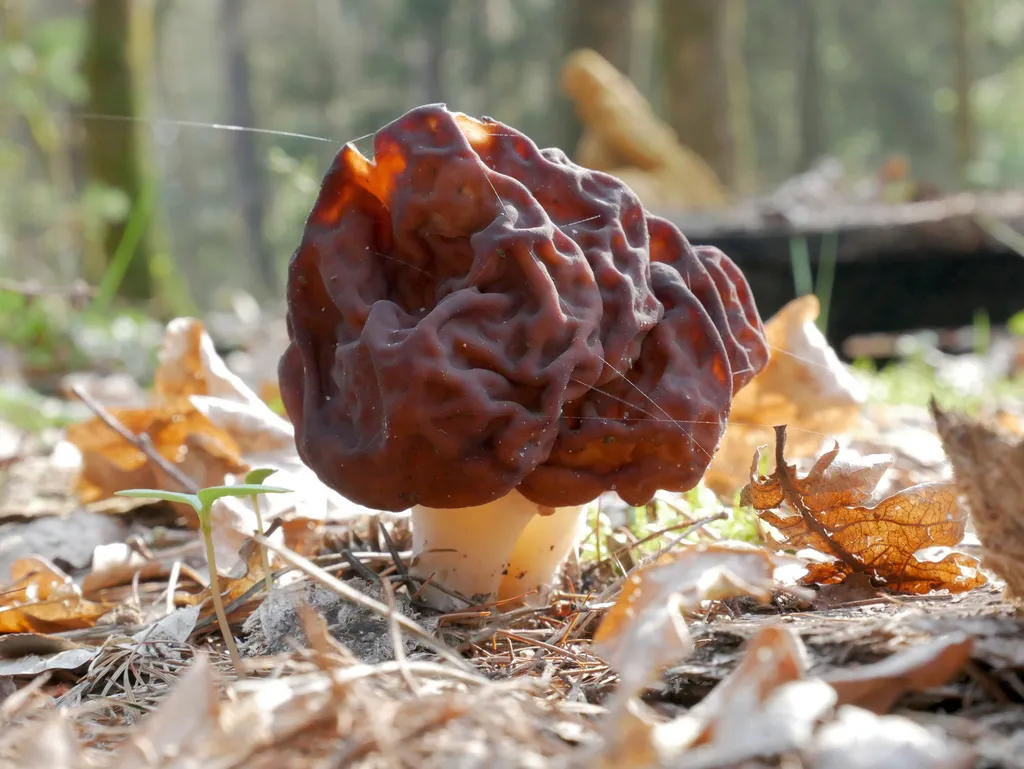
The false morel is a squat spring mushroom with a cap that looks like a brain or a folded saddle: lobed, wrinkled and irregular, in red-brown, chestnut or tan, sitting on a short, pale, fragile stem. It is usually wider than it is tall, and the cap bulges out over the stem rather than sitting on top of it like a morel. Cut lengthwise, the cap folds into irregular hollow chambers and the stem has several tube-like hollows, never the single clean cavity of a true morel. Other Gyromitra species (the big red false morel G. caroliniana in Missouri, G. gigas, G. infula in autumn) share the wrinkled cap and the toxin risk.
| Feature | False morel (Gyromitra esculenta) |
|---|---|
| Cap | 5–15 cm across, 4–8 cm tall. Red-brown, chestnut or tan. Irregularly lobed, wrinkled and brain-like; no honeycomb of pits. Usually wider than tall, overhanging the stem. |
| Gills / underside | None. The underside of the cap is pale and the cap is folded into irregular hollow chambers. |
| Stem & base | 2–5 cm tall, 2–3 cm thick, creamy white, fragile. Inside: several irregular tube-like hollows, not one chamber. No ring, no sac. |
| Flesh | Brittle. Cut in half: chambered or cottony, not hollow. |
| Spore print | Yellowish buff. |
| Smell | Not distinctive. Never taste it. |
| Habitat | On the ground, usually sandy soil, in conifer woodland and especially under pines; also disturbed ground. |
| Season | Spring and early summer, the same weeks as true morels. |
| Range (US / UK & Europe) | Many parts of North America; in Missouri the common false morel is the related G. caroliniana. Throughout Europe; widespread but local in Britain and Ireland, more common in hill country. |

Confirm these features
- A cap that is wrinkled, folded or brain-like, with no regular pits and ridges.
- Reddish-brown, chestnut or tan colour; the cap is usually wider than tall and overhangs the stem.
- Cut lengthwise: chambers, folds and cottony tissue inside, with several hollows in the stem instead of one.
- A short, thick, fragile cream stem, often grooved.
- Growing on the ground in spring, often sandy soil, often under pines.
Why one feature is never enough: colour is a poor guide, because some false morels are tan and some true morels are brown, and a battered old morel can look wrinkled. The cut is the test that does not lie: one open hollow means a morel, chambers mean a false morel. Do it on every specimen in the basket, not one.
Dangerous look-alikes
The danger with a false morel runs the other way: the risk is picking it while hunting something edible. These are the species it gets confused with.
True morel (Morchella species)
Tell apart: a true morel has a honeycomb cap of pits and ridges, the cap is fused to the stem, and it is hollow from top to bottom with no filling. A false morel is wrinkled, overhangs the stem and is chambered inside. Risk: they share the same woods and the same spring weeks; a basket of morels with one false morel in it is a poisoning. See morel vs false morel and our morel identification page.
Elfin saddles (Helvella crispa and relatives)
Tell apart: a creamy-white or grey saddle-shaped cap on a deeply ribbed stem with longitudinal channels inside. Risk: not a mushroom to eat on a guess; the Missouri Department of Conservation lists it with the morel look-alikes.
Other Gyromitra species
Tell apart: they do not need telling apart for safety. The big red false morel (G. caroliniana), the snow morel (G. gigas) and the autumn-fruiting hooded false morel (G. infula) all have wrinkled caps and chambered interiors. Risk: the North American Mycological Association lists several of them under the same gyromitrin syndrome. Treat the whole group as poisonous.
Where and when it grows
Gyromitra esculenta grows on the ground in conifer woodland, most often on sandy soil under pines, and on disturbed ground such as track edges. It fruits in spring and early summer, which is why it ends up in morel baskets. In North America it is found in many regions; in Missouri the common species is the big red false morel, G. caroliniana. In Britain and Ireland it is widespread but rarely recorded and very local, more often in hill country than in the lowlands; it occurs throughout Europe. First Nature notes that toxicity varies by region, with eastern European collections considered more dangerous than North American ones, and that high-mountain specimens are less toxic than lowland pine-forest ones. None of this makes any individual mushroom safe.
Symptoms and why the delay matters
The toxin is gyromitrin. The North American Mycological Association puts the onset at 2 to 24 hours after eating: headache, abdominal pain, severe diarrhea and vomiting, and in serious cases damage to the liver, kidneys and red blood cells, possibly resulting in death. First Nature describes death following five days to a week after the meal in the worst cases, and both sources note that cooking reduces the toxin without guaranteeing safety; NAMA adds that in Europe it has sometimes only been the cooks who died, and notes that the toxin is volatile. Poison centers put it simply: cooking a poisonous mushroom does not make it safe, and symptoms may take hours to appear, so call before they do.
The delay means a person can feel fine after a false morel dinner, go to bed, and wake ill. If anyone may have eaten one, use the numbers at the top of this page now, and keep a piece of the mushroom for the doctor.
Using an app to check a find
A photo can show the wrinkled, brain-like surface and the overhanging cap, which is often enough to raise the alarm, but it cannot show the inside, and a pale, less wrinkled specimen can pass for a brown morel from the outside. Mycoscout puts the edibility verdict at the top of every result, shows how confident it is and names the morel look-alikes with how to tell them apart; a "do not eat" verdict is worth acting on, and no result replaces the cut. iNaturalist can put your photos in front of human identifiers for free, and in morel season many local mycological societies run forays where someone experienced will look at your whole basket.
Frequently asked questions
What does a false morel look like cut in half?
The cap and stem are divided into irregular chambers, or filled with cottony tissue, with several tube-like hollows in the stem. A true morel cut the same way is one continuous empty hollow from cap tip to stem base.
Are false morels poisonous?
Yes. They contain gyromitrin. Symptoms start 2 to 24 hours after eating: headache, stomach pain, vomiting and severe diarrhea, and in serious cases liver, kidney and blood damage that can be fatal. Call poison control now if someone has eaten one.
Can you eat false morels if you cook them?
Not reliably. Cooking reduces the toxin but does not guarantee safety, toxin levels vary from place to place, repeated meals can build up, and people have died, including, per the North American Mycological Association, people who only cooked them. The Missouri Department of Conservation says to treat all false morels as toxic.
Where do false morels grow?
On the ground, often sandy soil, in conifer woods and under pines especially, in spring and early summer. They are found across Europe and in many parts of North America, often within sight of true morels.
Sources
How we checked this page: the Mycoscout team cross-checked every edibility, toxicity and look-alike statement against the sources below on October 31, 2026. It has not been reviewed by a mycologist.
- Mushroom poisoning syndromes: gyromitrin, North American Mycological Association. Accessed October 31, 2026.
- Gyromitra esculenta, False Morel, First Nature. Accessed October 31, 2026.
- False Morels (Gyromitra spp.), Missouri Department of Conservation. Accessed October 31, 2026.
- Morels (Morchella spp.), Missouri Department of Conservation. Accessed October 31, 2026.
- Wild mushrooms, Minnesota Poison Control System. Accessed October 31, 2026.
