 Mycoscout
How to identify a fly agaric
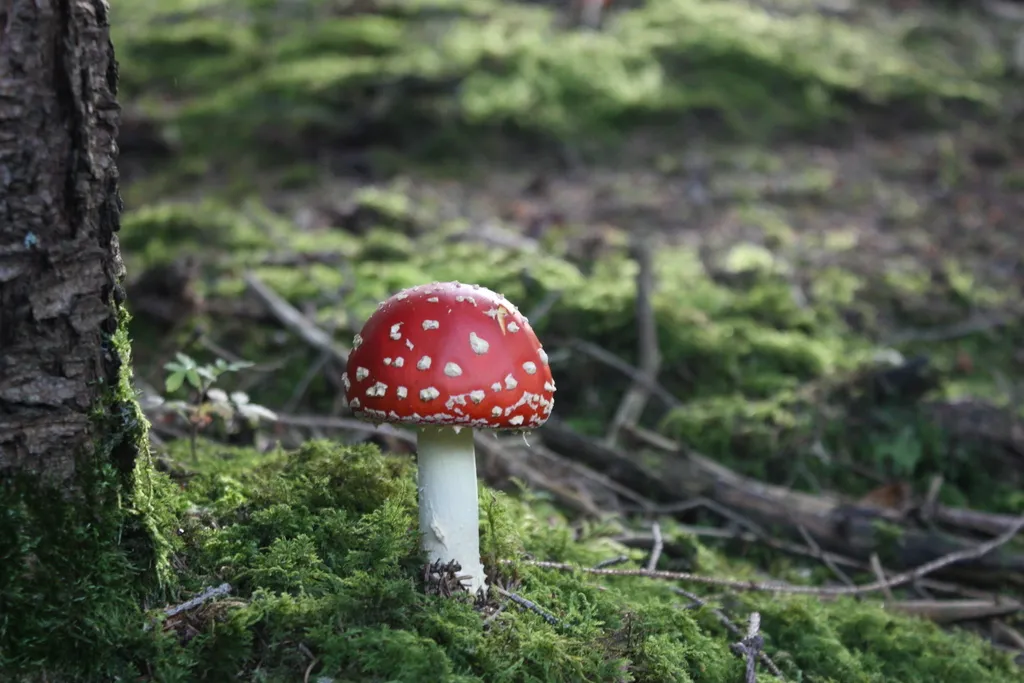
Fresh, the fly agaric is unmistakable: a bright red cap dotted with white warts, white gills, a white stem with a hanging ring and a swollen base ringed with scales. It grows under birch, pine and spruce from late summer to early winter. The difficulty starts when it is not fresh: heavy rain washes the warts away, sun fades the cap to orange or yellow, and an old one can look like a plain orange amanita. Orange forms also occur naturally. The ring, the scaly bulb and the white gills then do the identifying, and they have to be checked before anyone decides a red or orange mushroom is one of the edible amanitas.
| Feature | Fly agaric (Amanita muscaria) |
|---|---|
| Cap | 10–20 cm across. Scarlet, occasionally orange; fades with age and sun. Domed, then flat or slightly dished. Covered in pointed white warts (veil remnants) that rain or animals can remove. |
| Gills / underside | White, free of the stem, crowded; pale yellow in old specimens. |
| Stem & base | 10–25 cm tall, 1.5–2 cm thick, white and ragged, with a grooved, hanging white ring. The base is a swollen bulb with rings of white scales around it, the remains of the veil; no open sac. |
| Flesh | White; yellowish just under the cap skin. |
| Spore print | White. |
| Smell | Not distinctive. |
| Habitat | With trees it partners: birch above all, also pine and spruce, on light soils in woodland and heath. |
| Season | UK and Ireland: August to November; late summer to early winter generally. |
| Range (US / UK & Europe) | Common across the northern hemisphere: Britain, Ireland, mainland Europe, Asia, the US and Canada. Often returns to the same spot year after year. |


Confirm these features
- Red to orange cap with white or cream warts, or the smooth cap of one that has lost them.
- White gills that do not reach the stem.
- A hanging white ring on the upper stem.
- A swollen base with concentric rings of white scales, not an open white sac.
- A white spore print.
- Growing on the ground near birch, pine or spruce.
Why one feature is never enough: "red with white spots" is only true of a fresh fly agaric in dry weather. A rained-on one is a plain red cap; a faded one is orange; a young one is a white-studded ball. The ring, the scaly bulb and the white gills are what remain, and they are also what an edible orange amanita does not share.
Dangerous look-alikes
Caesar's mushroom (Amanita caesarea)
Tell apart: a brilliant orange cap with a lined (striated) margin and no warts, and a yellow stem. The fly agaric has a white stem, white gills and a scaly bulb. Caesar's mushroom is a southern European species, rarely seen in the north. Risk: a faded, wart-less fly agaric is the classic reason a "Caesar's mushroom" turns out to be poisonous.
The blusher (Amanita rubescens)
Tell apart: a pale reddish-brown to orange cap with greyish-cream patches; its stem and flesh turn pinkish red where damaged. Fly agaric flesh stays white or yellows slightly. Risk: a dull fly agaric with cream warts resembles it, and anyone sorting the two on cap colour alone can end up with a fly agaric in the basket.
Beechwood sickener (Russula nobilis) and other red brittlegills
Tell apart: a bright red cap but no ring, no bulb and no warts, with brittle flesh that snaps like chalk. Risk: a poisonous mushroom itself, so confusion is not reassuring either way.
Panther cap (Amanita pantherina) and other warty amanitas
Tell apart: the panther cap is brown with white warts and a rimmed bulb; it is poisonous too. Risk: both share the "warty amanita" look; neither is for eating.
Where and when it grows
The fly agaric partners with the roots of birch, pine and spruce, so it appears on the ground within reach of those trees, in woodland, on heaths, in parks and in gardens with a birch in them, often in groups and often in the same place year after year. In Britain and Ireland it fruits from August to November and is common wherever birch grows; it is native there. It is common across mainland Europe, Asia, the United States and Canada, and has been introduced with planted trees to Australia and New Zealand. Dog walkers meet it most in October and November, which is why it appears on our dog ate a mushroom guide.
Symptoms and why the delay matters
The fly agaric contains ibotenic acid and muscimol, with smaller amounts of related compounds. Unlike the death cap, its toxins act fast: the North American Mycological Association puts the onset at 30 minutes to 2 hours after eating, lasting several hours. Symptoms are mainly on the nervous system: confusion, nausea, drowsiness and in some cases convulsions, with some victims falling into a sleep they cannot be roused from. Recovery is usually spontaneous, and NAMA records no reliably documented human death from the toxins in the past 100 years, but it also records a camper who froze to death while comatose, and it warns that dogs and especially cats can die. First Nature notes that raw fly agaric causes severe stomach upset and that cooking does not remove all the toxins. Poison centers say the same of every poisonous mushroom: cooking does not make it safe.
For a child or a pet, the short delay is the warning: if anyone has eaten part of a red-and-white mushroom, use the emergency numbers at the top of this page now, and for a dog or cat call the vet immediately.
Using an app to check a find
A fresh fly agaric is the easy case, and a photo of the cap alone gives an app its easiest case. The hard cases are the faded, wart-less caps and the young buttons, where an app needs the gills, the ring and the base to separate it from other amanitas. Mycoscout asks for those angles, puts the verdict at the top of the result, shows its confidence and names the look-alikes to rule out. A "Poisonous, do not eat" verdict is worth acting on; no verdict from an app or a web page clears a mushroom for eating. For free alternatives, iNaturalist puts your photos in front of human identifiers, and a local mycological society can examine the whole specimen.
Frequently asked questions
Is fly agaric poisonous to touch?
Touching one is not reported as a route of poisoning; the toxins act when it is eaten. Wash your hands afterwards, and do not let children or dogs mouth one.
Is fly agaric deadly?
Rarely for people: the North American Mycological Association says there are no reliably documented deaths from its toxins in the past 100 years, though victims can fall into a deep sleep they cannot be roused from. Dogs and especially cats can die from eating it. Treat any ingestion as an emergency and call poison control or a vet now.
Is fly agaric a toadstool?
Yes, in the everyday sense. Toadstool has no scientific meaning; it is the common word for a poisonous mushroom, and the fly agaric is the one most people picture.
Is fly agaric poisonous to dogs?
Yes. The North American Mycological Association warns that dogs, and especially cats, can die from fly agaric toxins. If a dog has eaten any part of a red-and-white mushroom, call your vet or an animal poison line immediately.
Sources
How we checked this page: the Mycoscout team cross-checked every edibility, toxicity and look-alike statement against the sources below on October 31, 2026. It has not been reviewed by a mycologist.
- Amanita muscaria, Fly Agaric, First Nature. Accessed October 31, 2026.
- Fly agaric (Amanita muscaria), Woodland Trust. Accessed October 31, 2026.
- Mushroom poisoning syndromes: ibotenic acid and muscimol, North American Mycological Association. Accessed October 31, 2026.
- Wild mushrooms, Minnesota Poison Control System. Accessed October 31, 2026.
